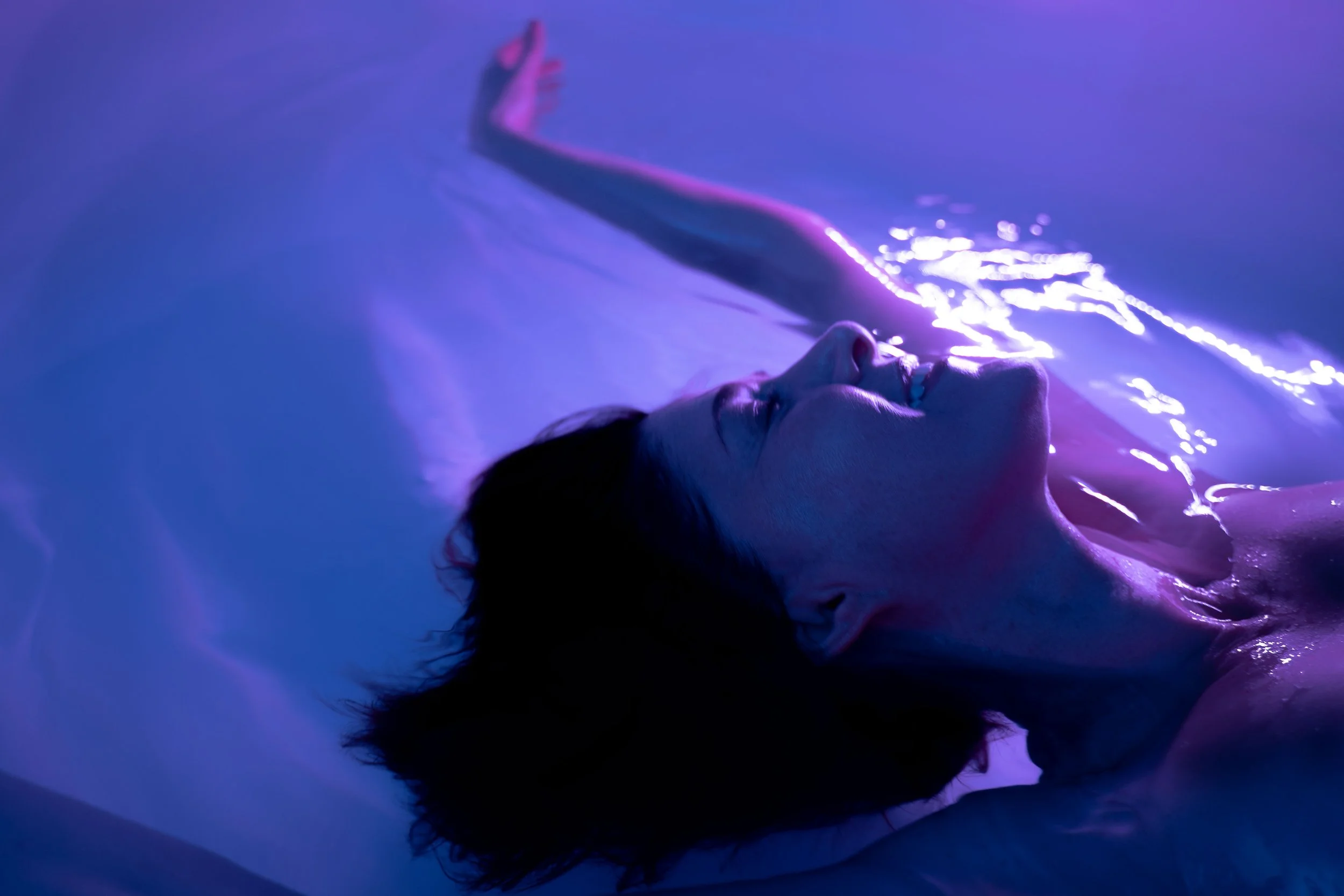
Why Spring Is the Best Time of Year to Start Floating
There's something about the shift from winter to spring that makes people want to change things up. Maybe it's the longer days, maybe it's the fact that you can finally leave the house without five layers on. Whatever it is, spring carries a built-in sense of possibility, and that makes it an ideal time to try something new for your body and your brain.
If float therapy has been on your "I should really try that" list, spring in Peterborough is the time to actually do it.
Here's why the season and the practice are such a natural fit together.
Your Nervous System Has Been Working Overtime
Winter in Ontario is long. Between the short days, the cold, the holidays, and the general slog of January through March, your nervous system has been running in survival mode for months. That low-grade tension you're carrying in your shoulders? The mental fog that won't quite lift? That's the accumulated weight of a season that asks a lot of you without giving much back.
Float therapy is one of the most direct ways to give your nervous system a break. When you step into a float tank, you remove almost every source of external stimulation: light, sound, gravity, and temperature fluctuation. Your body gets the signal that it's safe to stop bracing, and your brain gets space to process everything it's been holding onto. Many people find that even a single session helps them feel noticeably lighter and more clear-headed.
Spring is the natural time for that kind of reset. You're already in transition mode, so leaning into something restorative just makes sense.
Spring Energy Without Spring Overwhelm
Here's the thing about spring: it's exciting, but it can also be a lot. There's pressure to get back out there, start new projects, catch up on everything you put off during winter, and somehow also enjoy the nice weather. It's easy to go from hibernation mode straight into overdrive without ever actually resting in between.
Floating gives you a built-in pause. A 60- or 90-minute session in a sensory deprivation tank isn't just relaxation for the sake of it. It's a chance to sort through your thoughts, figure out what actually matters to you this season, and come out with more clarity about where to put your energy. Some of the most productive thinking happens when you're doing absolutely nothing, and the float tank is purpose-built for that kind of mental space.
The Seasonal Shift Supports New Habits
If you've ever tried to start a new wellness habit in January, you know how hard it is to stick with something when it's dark at 4:30 p.m. and you'd rather be under a blanket. There’s a lot to overcoming the inertia of even our most well-intentioned New Year’s resolutions.
Spring is different. The energy is already shifting in your favour: more daylight, warmer temperatures, a general sense of momentum.
That makes spring an excellent time to build a float practice into your routine. Whether you're coming in once a month or every couple of weeks, starting when the season is already pulling you toward renewal makes it easier to keep going. Many of our regulars at Flow Spa started floating in spring and found it became a cornerstone of how they manage stress and stay focused through the busier months ahead.
How Float Therapy Helps You Actually Reset for Spring
Here's what happens when you step into the tank:
Your nervous system finally downshifts
Inside the float tank, there's no light, no sound, no gravity pulling on your joints. Your brain stops processing external input and your sympathetic nervous system gets to quiet down.
This activates the parasympathetic response where real recovery happens. Your body pumps out dopamine and endorphins, stress hormones drop, and your system starts to recalibrate.
For a nervous system that's been running on fumes all winter, this is like finally pulling into the station and filling the tank.
Your sleep quality improves
One of the biggest complaints in early spring is disrupted sleep. The time change of springing forward with Daylight Savings, shifting light patterns, and accumulated stress all conspire to make your nights restless.
Floating helps on multiple levels. The deep relaxation response carries into your evening. The magnesium absorption from the Epsom salt (roughly 1,000 lbs of it in each float cabin) supports muscle relaxation and sleep quality. And the mental quiet you experience in the tank helps break the cycle of racing thoughts that keeps so many people staring at the ceiling at midnight.
Many of our clients at Flow Spa report that the night after a float is one of the best sleeps they get all month.
Mental fog lifts and clarity returns
Spring brain fog is real. When your nervous system has been stuck in overdrive for months, your prefrontal cortex — the part of your brain responsible for focus, decision-making, and creative thinking — gets less bandwidth.
Floating reverses that equation. With zero external demands, your brain has room to process, consolidate, and reset. People regularly leave the tank describing a feeling of being unbothered, like someone cleared the tabs and the desktop is finally clean.
If you've got big decisions to make, creative projects to start, or just want to think clearly again, a float can give your brain the room it needs.
Your body gets a physical reset too
It's not just mental. Floating in body-temperature water saturated with Epsom salt takes the load off your joints, spine, and muscles in a way that nothing else can replicate.
If you've been carrying winter tension in your neck and shoulders, dealing with low-back stiffness from months of less movement, or just feeling physically compressed, an hour of weightlessness can do wonders.
The magnesium in the water also supports:
Muscle relaxation and reduced soreness
Healthy circulation
Recovery from physical activity as spring training ramps up
Reduced inflammation
It's a full-system reset in a single session.
Pair It With the Rest of Your Spring Reset
Float therapy works well on its own, but it also pairs beautifully with other recovery modalities. If you're already thinking about getting more active this spring, consider combining a float with contrast therapy (alternating between our infrared sauna and cold plunge) to support your body through the transition. Or if you're looking for a more complete recovery session, add Normatec compression after your float to help your legs recover from those first spring runs.
The point isn't to stack as many treatments as possible. It's to find what combination helps you feel your best, and spring gives you the fresh headspace to experiment.
You Don't Have to Be a "Wellness Person"
One of the most common things we hear from first-time floaters at Flow Spa is some version of, "I didn't think this was for me." Float therapy isn't just for meditation practitioners or elite athletes. It's for anyone who thinks a lot, carries stress in their body, or just wants an hour where nobody needs anything from them.
If you're curious but skeptical, spring is a low-pressure time to give it a shot. You're already in the mood to try new things. The worst case scenario is that you spend 60 minutes floating in warm water in total quiet. That's a pretty good worst case.
Frequently Asked Questions
What is float therapy, and what should I expect for my first session in Peterborough?
Float therapy involves floating in a tank filled with warm water and about 1,000 pounds of Epsom salt, which makes you completely buoyant. You float effortlessly in a dark, quiet space for 60 or 90 minutes. Most first-timers are surprised by how quickly they relax. You can learn more on our About Floating page.
How often should I float to see benefits?
Many people notice a difference after just one session, but the benefits tend to build with consistency. Floating once or twice a month is a great starting point. Some of our regulars come weekly, especially during busier seasons.
Is float therapy good for stress and anxiety?
Many people find that floating helps reduce stress and quiet mental chatter. The combination of sensory reduction and the magnesium in the Epsom salt may support relaxation and nervous system regulation. It's not a replacement for professional mental health support, but it can be a valuable part of your overall wellness routine.
Can I combine floating with other services at Flow Spa?
Absolutely. Many of our guests in Peterborough, Ontario pair a float with an infrared sauna session, cold plunge, or Normatec compression. We're happy to help you figure out what combination works best for your goals.
I'm claustrophobic. Can I still float?
This is one of the most common concerns, and the answer is almost always yes. Our float cabins are spacious, and you're always in control. It’s like being in a big room with a ton of overhead space. You can leave the door open, keep a light on, or ease in at your own pace. Most people who are nervous about it end up feeling completely comfortable within the first few minutes.
How do I book a float session at Flow Spa?
You can book online anytime, or give us a call if you have questions before your first visit. We'd love to see you this spring.
Spring is already doing the heavy lifting when it comes to fresh starts. All you have to do is show up and float. If you've been thinking about trying it, this is your sign.
Ready to see what float therapy feels like? Book your first session at Flow Spa and start your spring a little lighter.
Book your float online
Or give us a call at 705-230-8575 to find an appointment time that works for you.

How High Performers Use Recovery Blocks to Avoid Burnout
One week you're crushing deadlines, riding a wave of energy and focus. The next, you can barely drag yourself out of bed. Your brain feels foggy. Your shoulders are up near your ears. And no amount of coffee is fixing it.
Sound familiar?
Here's the thing most people get wrong about burnout: they treat recovery as a reward for hard work. Something you earn after you've run yourself into the ground.
But the highest performers in the world — athletes, entrepreneurs, creatives — do the opposite. They build recovery into the work.
They schedule it like a meeting.
They protect it like a deadline.
They use what I call Recovery Blocks and it's the reason they can sustain high output without crashing.
Recovery Isn't What You Think It Is
When most people hear recovery, they picture lying on the couch binge-watching Netflix. That's passive recovery. It'll eventually get you back to baseline, but it won't move the needle. In fact, a lot of what passes for rest — scrolling your phone, watching TV, playing video games — actually keeps your nervous system in a state of low-grade stimulation.
You're not recovering. You're just zoning out.
What high performers practice is something different. It's Deliberate Recovery — intentionally engaging in activities that shift your nervous system from fight or flight back into rest and repair. The kind of recovery that's deep enough to allow you to recharge and not just distract you for a bit.
Think of it this way: passive recovery is hoping the car refuels itself. Deliberate Recovery is pulling into the station and filling the tank.
The Growth Equation
Brad Stulberg and Steve Magness nailed this with what they call The Growth Equation:
Stress + Rest = Growth.
You need the strong stimulus — the challenging work, the deep focus sessions, the physically demanding training — to create the adaptation. But that change only sticks if you don't break down too far and allow enough recovery afterward.
The problem we most often face today is that stress is cumulative from all areas of your life. Work deadlines, family demands, financial pressure, poor sleep — it all piles on the same nervous system. And most of us are being hit hard from multiple directions without enough recovery in between.
When the stress outpaces the rest, the equation breaks down. That's when burnout shows up — not with sirens, but disguised as dedication to grinding a little bit harder.
What the Pros Actually Do
The world's best performers have built recovery into their operating systems:
Steph Curry uses float therapy for mental reset and focus between games and practices.
Tom Brady was so committed to floating that he kept a tank in his home during his playing career.
Lady Gaga cycles through ice baths, hot baths, and compression after performances — a textbook contrast therapy protocol.
Jeff Bezos schedules his life around 8 hours of sleep every night. His reasoning? "I think better. I have more energy."
Andre Iguodala's NBA performance measurably improved when he started prioritizing sleep — documented during the Warriors' championship run.
None of these people view recovery as optional. They see it as part of the performance infrastructure. Recovery is the foundation that makes everything else possible.
Why Recovery Blocks Work
A Recovery Block is a scheduled period — anywhere from 30 minutes to a half-day — where you deliberately engage your parasympathetic nervous system. The "rest and digest" side. The side that handles healing, memory consolidation, and emotional processing.
When you do this consistently, several things happen:
Your nervous system learns to shift gears.
Most of us are stuck in sympathetic overdrive. We’re always on, always alert. Recovery Blocks train your body to toggle between activation and rest. Over time, you become more resilient to stress, not less.
Your brain consolidates what you've learned.
Flow states and deep work generate a flood of neurochemistry. But the learning doesn't lock in until you rest. Skip recovery, and you're leaving performance gains on the table.
Your body actually heals.
Inflammation drops. Circulation improves. Sleep quality goes up. You wake up with the kind of energy that used to take three espressos to fake.
Your creativity comes back.
In Creativity: The Psychology of Discovery and Invention, Mihaly Csikszentmihalyi found that creative individuals often develop rituals to distract themselves and avoid mental overload — activities like walking, playing solitaire, or running errands give the mind a break and allow ideas to incubate. Recovery isn't the absence of productivity. It's where the next breakthrough comes from.
How to Build Recovery Blocks Into Your Week
You don't need a pro athlete's schedule (or budget) to do this well. You just need to be intentional about it.
Here are some simple rules to implement:
The 90/20 Rule
Your brain works in natural cycles — roughly 90 minutes of focused effort followed by a need for recovery. Most of us blow right past those signals and wonder why we're fried by 2 PM.
Try working in 90-minute deep work blocks followed by 20 minutes of genuine recovery. Checking your phone doesn’t count! Commit to actually recovering. A short walk, some breathing, stepping outside. Let your system come back down before the next push.
Daily Recovery (10–30 Minutes)
This is your baseline.
Every day, without exception:
5–10 minutes of slow breathing or meditation. Inhale for 4–5 seconds, exhale for 6–8. This is the cheapest, highest-ROI lever you have.
A phone-free walk for daylight and mental decompression.
A consistent wind-down before bed. Dim the lights 60–90 minutes before sleep. Protect your sleep like the performance tool it is.
Weekly Deep Reset
Once a week, schedule something that goes deeper than a walk and some breathing. This is where the real compound interest of recovery happens.
Float therapy is unmatched for mental clarity and nervous system recalibration. Remove all sensory input for an hour and your brain finally has room to process.
Infrared sauna on training days or high-workload days to loosen tissue, support circulation, and improve sleep quality.
Contrast therapy — alternating hot and cold — for physical recovery after hard training weeks or intense sprint periods at work. The rhythm of rounds gives the session structure and keeps you present. It’s a great forcing function if you can’t convince yourself to try a float.
Monthly Check-In
Once a month, step back and honestly assess: Am I recovering enough for what I'm demanding of my system?
Ask yourself:
When was the last time I felt genuinely energized after challenging work?
Am I sleeping as well as I was over the last couple of months?
Do small problems feel heavier than they should?
If more than one of those raises a flag, it's time to adjust.
The Five Qualities of Deliberate Recovery
Not all recovery is created equal.
The kind of recovery that actually moves the needle has five characteristics:
1. It's Deliberate.
You think about it. You plan it. You schedule it. Like deliberate practice is essential for mastery, Deliberate Recovery is essential for sustaining the energy that mastery demands.
2. It's Gritty.
Choosing recovery when your default is to keep grinding takes discipline. The first step — closing the laptop, booking the session, putting on your shoes for a walk — that's a display of grit. Perseverance and grit are about working harder but also knowing when it’s time to stop and recovery.
3. It's Deep.
Deliberate Recovery works on your whole system — your muscles, but your nervous system, your mental clarity, your emotional bandwidth. It's a comprehensive restoration that passive rest can't match.
4. It's Productive.
You're not checking off a to-do list, but you're productively enhancing your capacity. A cold plunge reduces inflammation and restores focus. A sauna promotes blood flow and forces adaptation. A float clears the mental slate. These practices are investments in how you continue to show up.
5. It's Mindful.
The activities themselves — floating in silence, breathing in a sauna, sitting with the shock of cold water — force you to slow down and be present. That mindfulness component is what shifts your nervous system from reactive to regulated.
Common Mistakes (and How to Fix Them)
Only recovering when you're already burned out.
By the time you feel burned out, you're weeks behind on recovery. Fix: Put Recovery Blocks on the calendar proactively, not reactively. Consistency beats intensity.
Treating recovery as a one-off treat.
A single float or sauna feels great, but the benefits compound over time. Try different techniques, stack 4–6 weeks of consistent recovery blocks, and you'll notice a real shift in your baseline energy, sleep, and stress tolerance.
Skipping the mental side.
5–10 minutes of breathwork or meditation daily costs you nothing and changes everything. Don't overlook it because it seems too simple.
Confusing passive downtime with real recovery.
Netflix on the couch isn't recovery — it's a passive distraction. There's nothing wrong with it, but you shouldn’t count it as a Recovery Block.
What This Looks Like in Practice
Imagine you're an entrepreneur running a business. Your weeks are packed — client calls, operations, marketing, putting out fires. You're performing well, but you can feel the edges starting to fray.
Here's what a Recovery Block system could look like for you:
Monday morning: 10 minutes of breathwork before opening your laptop. Set the tone for the week.
Wednesday evening: 60-minute float at Flow Spa. Use it to process the first half of the week and reset for the second half.
Saturday afternoon: Contrast therapy session. Flush out the week's accumulated tension and set yourself up for a genuinely restful weekend.
Daily: Phone-free walk at lunch. Wind-down ritual at night.
Monthly: Massage therapy session to address whatever's building up physically.
Compared to everything else we do, it’s not a lot of time on the schedule. But it's the difference between grinding through months on fumes and sustaining high performance for years.
Recovery Is Performance Infrastructure
The biggest mindset shift high performers make is this: recovery isn't something you earn after burning out. It's what makes sustained performance possible in the first place.
You wouldn't run a business without maintaining your equipment. You wouldn't train for a race without rest days. Your body and mind are no different.
Recovery Blocks aren't a sign of weakness. They're a sign that you understand how performance actually works.
Your Next Move
You don't need to overhaul your entire life.
Start with one thing:
This week, schedule one recovery block. Put it on your calendar. Protect it the way you'd protect your most important meeting.
Whether it's a float, a sauna session, contrast therapy, or just 30 minutes of genuine, phone-free downtime — make it real.
Track how you feel and perform for the next 28 days. Keep what moves the needle.
Because the goal isn't to grind until you break, it's to perform at your best and feel good doing it for a long time.
When you're ready, book your next session at Flow Spa and start building recovery into your operating system — not as an afterthought, but as the foundation.
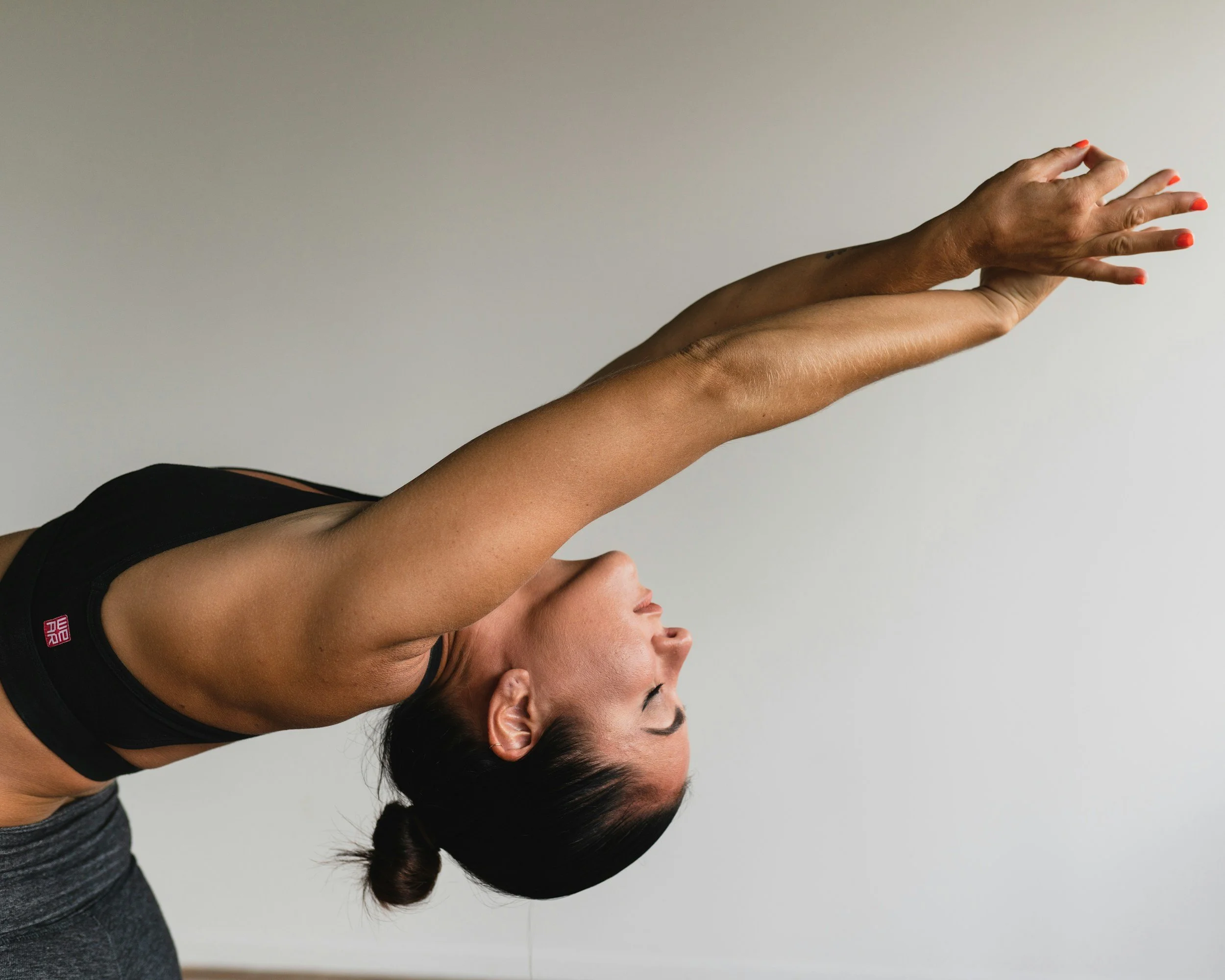
Fascial Stretch Therapy in Peterborough: What It Is, Who It's For, and Why It's Different from Massage
You stretch. You foam roll. Maybe you even do yoga a few times a month.
But something still feels stuck.
Your hips are tight. Your shoulders don't move the way they used to. You wake up stiff, even after a decent night's sleep. And no matter how much stretching you do on your own, it doesn't seem to get to the root of the issue.
If that sounds familiar, there's a good chance the problem isn't your muscles, it's your fascia.
Fascial Stretch Therapy (FST) is one of the most effective ways to address the deep, connective tissue restrictions that regular stretching can't reach. And it's available at Flow Spa in Peterborough with Nick Plummer, RMT.
Here's everything you need to know.
What Is Fascia (And Why Does It Matter)?
Fascia is the web-like connective tissue that wraps around every muscle, bone, joint, nerve, and organ in your body. Think of it like a full-body suit that holds everything in place and helps transfer force when you move.
When fascia is healthy, it's flexible and supple. You move freely, recover well, and don't think twice about reaching overhead or bending down.
But when fascia gets tight, sticky, or restricted, like from sitting all day, repetitive movements, injuries, stress, or just the wear and tear of life, things start to feel off:
Chronic stiffness that stretching doesn't fix
Reduced range of motion in your hips, shoulders, or back
Nagging pain that doesn't seem connected to a specific injury
A feeling of being "compressed" or locked up
Slower recovery after workouts or physical activity
Fascia is densely packed with sensory nerves. It's as much a communication system as it is structural support. When it tightens, it can send pain signals even when the muscle underneath is fine. That's why you can massage a sore spot over and over without lasting relief — the restriction lives in the fascial layer.
What Is Fascial Stretch Therapy (FST)?
Fascial Stretch Therapy is a table-based, assisted stretching technique that targets your entire fascial system, not just isolated muscles.
During a session, your therapist gently guides your limbs through specific, multi-directional movement patterns designed to:
Decompress joints and create space where things feel jammed up
Release fascial adhesions that limit your range of motion
Improve circulation and nutrient delivery to tissues
Stimulate your nervous system's relaxation response so your body actually lets go
Unlike traditional stretching, where you push into a position and hold, FST uses gentle, wave-like movements combined with traction and stabilization. Your therapist does the work while you relax into each stretch. There's no forcing, no bouncing, and no pain.
Most people describe the sensation as a deep, satisfying release. It feels as if your body finally has room to breathe.
How FST Is Different from Massage Therapy
This is the question we get most often: "If I already get massages, do I need FST too?"
Short answer: They do different things, and they complement each other beautifully.
| Massage Therapy | Fascial Stretch Therapy | |
|---|---|---|
| Primary target | Muscles and soft tissue | Fascia, joint capsules, and the connective tissue system |
| Technique | Compression, kneading, pressure | Assisted stretching, traction, multi-directional movement |
| Best for | Muscle tension, soreness, relaxation, pain relief | Mobility, flexibility, joint stiffness, movement quality |
| How it feels | Pressure into tissue | Gentle stretching and decompression |
| You are | Mostly still while the therapist works | Gently moved through ranges of motion |
| Afterward | Relaxed, tension reduced | Lighter, looser, more mobile |
Think of it this way:
Massage is like releasing the knots in a rope. FST is like creating slack in the entire net so the knots don't keep forming.
Both are valuable. But if your issue is mobility, stiffness, or restricted movement rather than just muscle soreness, FST may be the missing piece.
Who Is FST For?
Fascial Stretch Therapy isn't just for athletes or yoga enthusiasts. It's for anyone whose body feels like it's working against them.
Desk workers and professionals
If you sit for most of the day, your hip flexors, chest, and upper back fascia are likely shortened and restricted. FST opens up these areas in ways that self-stretching often can't reach. Many clients notice an immediate improvement in posture and a reduction in that "compressed" feeling after just one session.
Athletes and active individuals
Whether you run, cycle, lift, play sports, or train in any capacity, fascial restrictions can limit your performance and slow your recovery. FST helps maintain a healthy range of motion, reduces post-exercise soreness, and keeps your joints moving freely — so you can train harder and recover smarter.
People dealing with chronic stiffness or pain
If you've tried massage, stretching, and foam rolling but something still doesn't feel right, restricted fascia could be the culprit. Conditions like chronic low back pain, neck stiffness, hip tightness, and even headaches often have a fascial component that responds well to FST.
Anyone recovering from an injury
After an injury, scar tissue and fascial adhesions can form and limit your movement long after the initial healing is done. FST helps restore mobility and create better movement patterns during rehab.
Older adults or anyone feeling "locked up"
As we age, fascia naturally becomes less pliable. Regular FST sessions can help maintain flexibility, joint health, and ease of movement — making everyday activities feel smoother and less effortful.
What to Expect During Your FST Session at Flow Spa
If you've never tried FST before, here's what your visit looks like:
1. Check-in and assessment
Nick will ask about your goals, areas of concern, and movement history. This helps tailor the session to exactly what your body needs.
2. On the treatment table
You'll lie comfortably on the table — fully clothed in comfortable, stretchy clothing. Nick uses stabilization straps and gentle hand positioning to isolate specific fascial lines.
3. Guided stretching
You relax while Nick moves your body through a series of stretches. The movements are slow, controlled, and pain-free. You may be asked to breathe into certain stretches or provide light resistance at times.
4. The release
Most people feel a deep sense of opening, like joints and muscles that have been compressed suddenly have space. It's common to feel taller, lighter, and more relaxed afterward.
5. Post-session guidance
Nick may suggest simple movements or stretches to continue the progress between sessions.
Session lengths
Choose what fits your needs:
30 minutes — Focused work on one or two problem areas
45 minutes — Upper or lower body focus with more time to address patterns
60 minutes — Full-body session (our most popular option)
75 minutes — Extended work for complex restrictions or multiple areas
90 minutes — The most comprehensive session for full-body reset
Pairing FST with Other Recovery Modalities
One of the best things about FST at Flow Spa is that you can combine it with our other services for an even deeper reset.
FST + Float Therapy
Float before FST to soften tissue and calm your nervous system, or float after to let your body integrate the new range of motion in a completely weightless, distraction-free environment. Either order works beautifully.
FST + Infrared Sauna
Warm up with a 30-minute infrared sauna session before your FST appointment. Heat increases tissue pliability, which means Nick can work more effectively, and the stretches feel even more fluid.
FST + Contrast Therapy
For athletes or anyone in a heavy training phase, pairing FST with a contrast therapy session (infrared sauna + cold plunge) creates a powerful recovery stack: mobility work, circulation boost, and nervous system regulation all in one visit.
FST + Massage Therapy
If you're dealing with both muscle tension and fascial restriction, booking a massage and FST session together covers the full picture. Massage addresses the knots and soreness; FST addresses the underlying tightness and movement limitations.
The Insurance-Friendly Bonus
Here's something worth knowing: Fascial Stretch Therapy with Nick Plummer, RMT can be submitted to your health insurance plan just like a regular massage therapy appointment.
That means you can use your benefits for a treatment that specifically targets mobility and fascial health — not just general relaxation. If you've been sitting on unused RMT coverage, this is a great way to put it to work.
How Often Should You Book FST?
Like most recovery practices, consistency makes the biggest difference.
Getting started: Try 2–3 sessions within your first month to experience the cumulative effect. Most people notice significant changes after 2–3 visits.
Maintenance: Once every 2–4 weeks to sustain your mobility and prevent restrictions from building back up.
High-demand seasons: Weekly sessions during heavy training blocks, competition prep, or high-stress periods at work.
If you're not sure where to start, a single 60-minute session will give you a clear sense of how your body responds — and Nick can recommend a rhythm from there.
Frequently Asked Questions
What is fascial stretch therapy?
Fascial Stretch Therapy (FST) is an assisted stretching technique performed on a treatment table that targets the fascia — the connective tissue surrounding your muscles, joints, and bones. Unlike traditional stretching, FST uses gentle traction and multi-directional movements to decompress joints and release restrictions across your entire body.
Is fascial stretch therapy painful?
No. FST should feel like a deep, satisfying stretch — never painful. Your therapist works within your comfort level and adjusts throughout the session based on your feedback.
What should I wear to an FST session?
Wear comfortable, stretchy clothing that allows you to move freely — think athletic wear, yoga clothes, or anything you'd be comfortable stretching in. You stay fully clothed during the session.
How is FST different from yoga or regular stretching?
With FST, a trained therapist does the stretching for you — targeting specific fascial lines and joint capsules that are difficult to access on your own. It's also fully customized to your body's restrictions, whereas yoga follows a general sequence. Many people who practice yoga find that FST helps them break through plateaus in their flexibility.
Can FST help with back pain?
Yes. Many cases of chronic back pain involve fascial restrictions in the hips, thoracic spine, and surrounding connective tissue. FST addresses these restrictions directly, often providing relief that massage or stretching alone haven't achieved.
Where can I try fascial stretch therapy in Peterborough?
Flow Spa offers Fascial Stretch Therapy with Nick Plummer, RMT. Sessions are available in 30, 45, 60, 75, and 90-minute lengths, and can be submitted to your health insurance plan. Book your session online or call us at 705-230-8575.
Book Your Fascial Stretch Therapy Session in Peterborough
If you've been stretching, foam rolling, and doing "all the right things" but your body still feels restricted, it might be time to go deeper.
Fascial Stretch Therapy at Flow Spa gives your body the space it's been asking for — decompressed joints, released connective tissue, and a feeling of lightness that regular stretching simply can't match.
Book your FST session with Nick Plummer, RMT and feel the difference.
Or give us a call at 705-230-8575 to find an appointment time that works for you.
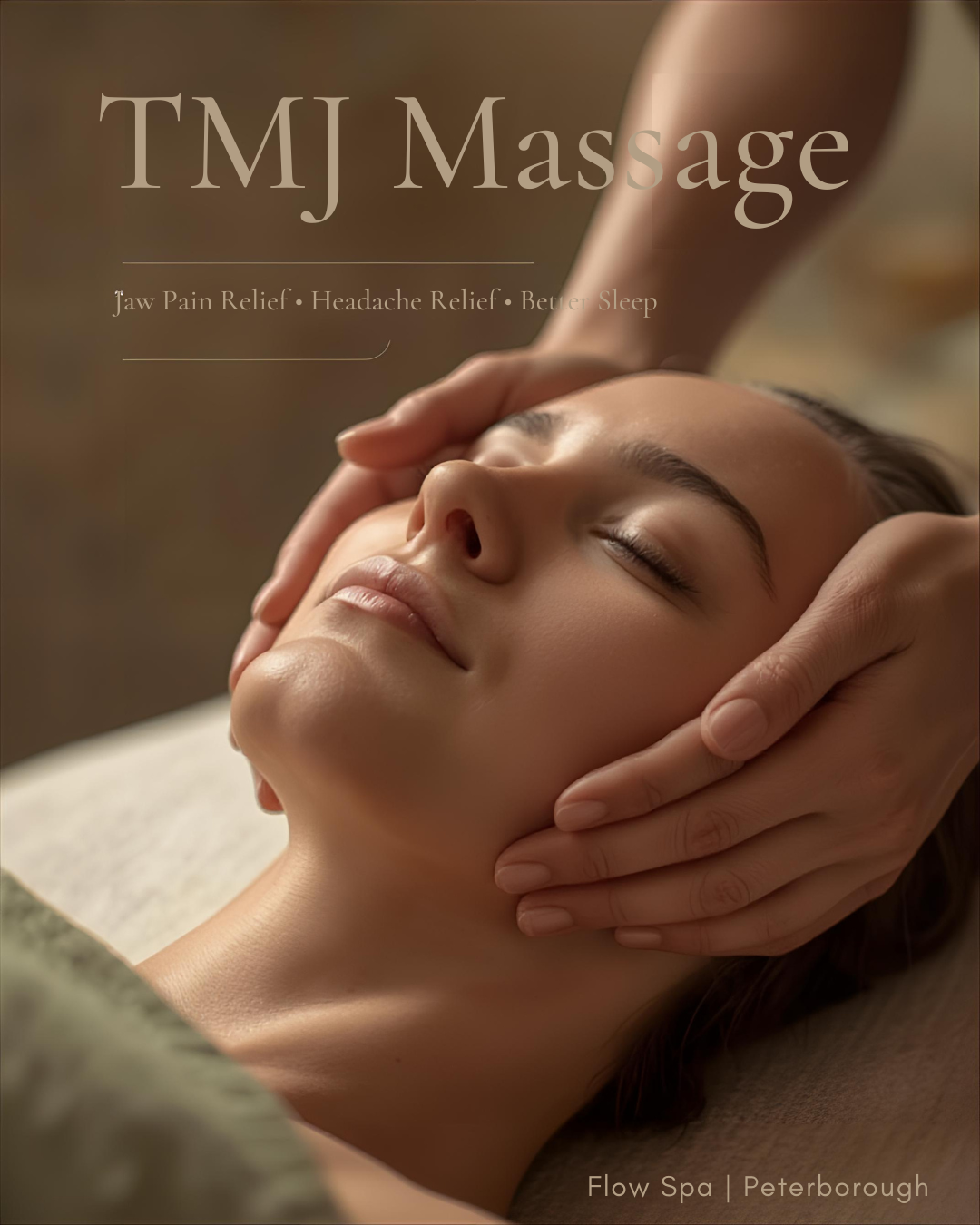
TMJ Massage in Peterborough: Relief for Jaw Pain, Headaches, and Tension
If you've been living with jaw pain, facial tension, clicking when you chew, or headaches that never seem to fully go away, you're not alone. Temporomandibular joint (TMJ) disorders affect millions of people, and the discomfort can quietly take over your day-to-day life.
TMJ massage is one of the most effective, non-invasive ways to find relief, and it's now available at Flow Spa in Peterborough.
What Is TMJ Disorder?
Your temporomandibular joints sit on each side of your head, just in front of your ears. They act like sliding hinges that connect your jawbone to your skull, making it possible to chew, talk, and yawn.
When these joints or the muscles around them become irritated, inflamed, or misaligned, the result is a TMJ disorder (also called TMD). Common causes include:
Teeth clenching or grinding (bruxism), especially during sleep
Stress, which leads to chronic jaw tightening
Jaw injury or trauma
Arthritis in the joint
Poor posture, particularly forward-head posture, from desk work
TMJ disorders are surprisingly common. Many people don't even realize their headaches, neck stiffness, or ear pain are connected to their jaw.
Symptoms of TMJ Dysfunction
TMJ issues show up differently for everyone, but here are some of the most common signs:
Pain or tenderness in the jaw, face, or around the ears
Clicking, popping, or grating sounds when opening or closing your mouth
Difficulty chewing or pain while eating
Locking of the jaw joint
Headaches or migraines, especially near the temples
Neck and upper shoulder tension
Ringing in the ears (tinnitus)
If any of these sound familiar, TMJ Massage in Peterborough: Relief for Jaw Pain, Headaches, and Tension at Flow Spa may be exactly what you need.
How TMJ Massage Works
TMJ massage is a targeted therapeutic approach that focuses on the muscles and soft tissue surrounding the temporomandibular joint. Unlike a general relaxation massage, TMJ massage is precise and purposeful.
Your Registered Massage Therapist (RMT) will work on key areas, including:
Masseter muscles — the powerful muscles along your lower jaw, responsible for clenching and chewing
Temporalis muscles — located at your temples, often a major source of TMJ-related headaches
Pterygoid muscles — deeper jaw muscles that can be accessed through intraoral (inside the mouth) techniques when appropriate
Neck and upper shoulder muscles — because jaw tension rarely stays isolated, it radiates into the surrounding areas
Techniques used during a TMJ massage may include gentle kneading, myofascial release, trigger point therapy, and stretching. These are all designed to release tension, improve circulation, reduce inflammation, and restore normal jaw movement.
Benefits of TMJ Massage
Regular TMJ massage can provide significant and lasting relief. Here's what you can expect:
Reduced jaw pain and tension — Direct work on the affected muscles helps break up tightness and adhesions
Fewer headaches — Many chronic headaches originate from TMJ dysfunction, and addressing the source can dramatically reduce frequency and intensity
Improved jaw mobility — Releasing restricted muscles helps restore a full, comfortable range of motion
Better sleep — If you clench or grind at night, reducing overall muscle tension can improve sleep quality
Lower stress levels — Therapeutic massage promotes relaxation and helps calm the nervous system
Decreased neck and shoulder pain — Since TMJ tension patterns often extend beyond the jaw, treatment addresses the full picture
Who Should Consider TMJ Massage?
TMJ massage isn't just for people with a formal diagnosis. You might benefit from this treatment if you:
Wake up with a sore or tight jaw
Catch yourself clenching during stressful moments
Have been told by your dentist that you grind your teeth
Experience frequent tension headaches
Feel tightness or pain when chewing
Carry a lot of stress in your face, jaw, or neck
Whether your symptoms are mild or have been building for years, TMJ massage in Peterborough at Flow Spa can be an important part of your recovery plan.
Meet Jess — Our Newest RMT at Flow Spa
We're excited to welcome Jessica Vautour to the Flow Spa massage team as our newest Registered Massage Therapist.
Jess is passionate about helping clients move better, recover faster, and address the root causes of their pain, making her an excellent fit for targeted treatments like TMJ massage. Whether you're dealing with chronic jaw tension, recovering from an injury, or looking for a therapist who really listens to what your body needs, Jess is here to help.
With Jess joining the team, we now have more appointment availability and expanded access to specialized treatments, like TMJ massage, right here in Peterborough.
What to Expect During Your TMJ Massage at Flow Spa
If you're booking a TMJ massage for the first time, here's what your visit will look like:
Intake conversation — Your RMT will ask about your symptoms, history, and goals for the session
Assessment — A brief evaluation of your jaw movement, posture, and areas of tension
Treatment — Focused massage work on the jaw, face, neck, and shoulders using a combination of techniques tailored to your needs
Home care tips — Your RMT may recommend simple jaw stretches or relaxation techniques to continue your progress between sessions
We offer TMJ massage in a range of session lengths so you can choose the right fit:
30 minutes — Focused jaw and face relief for acute symptoms
45 minutes — Jaw and neck work for those carrying tension in both areas
60 minutes — Our most popular option. Full attention to jaw, face, neck, and upper shoulders
75 minutes — Extended treatment with extra time for stubborn trigger points
90 minutes — The ultimate session, covering jaw through upper back for comprehensive relief
Book Your TMJ Massage in Peterborough
You don't have to keep living with jaw pain, tension headaches, and the daily discomfort that comes with TMJ dysfunction. TMJ massage at Flow Spa in Peterborough offers targeted, effective relief - delivered by registered, experienced massage therapists who understand how to treat the full pattern of tension.
Book your TMJ massage online
Or give us a call at 705-230-8575 to find an appointment time that works for you.
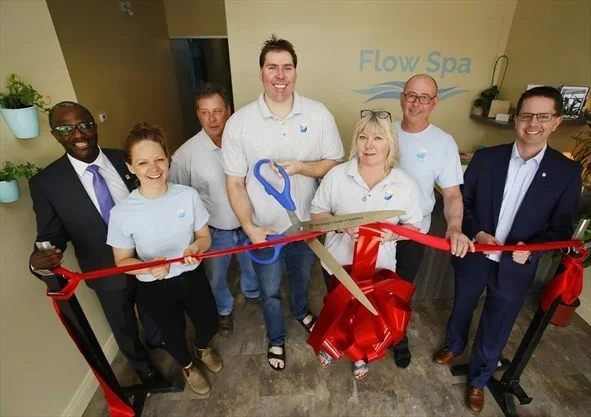
7 Lessons from 7 Years at Flow Spa
Seven years ago, Flow Spa opened its doors for the first time.
March 2, 2019. A Monday. I was nervous, excited, and had absolutely no idea what I was really getting into.
I knew I was passionate about health, recovery, and human performance. I had a double major in psychology and nutrition from the University of Toronto. I had competed at the top levels of natural strongman in Canada. And I was frustrated by the corporate world and wanted to build something that actually made a difference in people's lives.
So I built a float centre in Peterborough.
What followed was a journey that no business plan, no book, and no mentor could have fully prepared me for.
A pandemic that shut us down mere months into our momentum.
Lockdowns that tested every ounce of belief I had in this vision.
And then, slowly, a rebuilding that brought us to where we are today: a full wellness centre offering float therapy, infrared sauna, contrast therapy, cold plunge, massage, and psychotherapy, all under one roof.
Seven years later, I want to share the 7 biggest lessons this journey has taught me.
Some are about business. Some are about wellness. Most are about both, because at the end of the day, the same principles that help your body recover are the same ones that help a business survive and grow.
1. Recovery Creates Productivity — Not the Other Way Around
This is the single biggest lesson I've learned, and it's become the foundation of everything we stand for at Flow Spa.
We live in a culture that celebrates the grind.
More output.
More hours.
More hustle.
And when we eventually crash, we're told we've earned a rest.
But that's backwards.
Recovery isn't the reward for hard work. Recovery is what makes hard work sustainable.
I've seen this play out with thousands of clients over the years. The ones who build regular recovery into their routines — a weekly float, a consistent sauna practice, a real wind-down ritual before bed — are the ones who show up sharper, calmer, and more resilient week after week.
The same has been true for running the business. The weeks where I protect my own recovery time are the weeks I make better decisions, write better content, and lead with more patience.
Sometimes the most productive thing you can do is truly rest. I believed that when we opened. Seven years later, I feel that even more deeply in my body.
2. Surviving Requires Gratitude, Not Just Grit
Flow Spa opened in March 2019.
Exactly one year later — almost to the week — the world shut down.
I remember watching the announcement and feeling my stomach drop. We had just hit our stride. Momentum was building. Clients were coming back regularly. And suddenly, the doors had to close.
What followed was a roller coaster. Months of closure. Brief reopenings. More lockdowns. Watching friends and fellow business owners in Peterborough lose everything they had built.
I won't pretend it was all grit and determination that got us through. There was a lot of luck involved. A lot of good timing. And an incredible community that stuck with us, read our emails, and came back the moment they could.
In my 3-year reflection, I wrote: "It seems as much good luck as anything that we made it through the pandemic when so many friends and businesses did not. True gratitude is the only way to look at that."
I still feel that way. Grit matters, but gratitude is what keeps you grounded when grit alone isn't enough.
3. Consistency Beats Intensity — In Wellness and in Business
If I could boil down every blog post, newsletter, and recovery plan I've ever written into one sentence, it would be this:
Small actions done consistently will always outperform big efforts done once.
A weekly float is more powerful than a single long recovery session when you're already burned out. A 10-minute bedtime ritual repeated every night does more for your sleep than a one-time sleep hack. A simple breathing exercise practiced daily builds more nervous system resilience than an intense workshop you attend once and forget about.
The same applies to running a business. We didn't grow Flow Spa through one viral moment or one big marketing campaign. We grew it by showing up consistently through writing a newsletter every week, publishing helpful content, being present in the community, and steadily improving the experience for our clients.
Consistency isn't glamorous. But it compounds. And after 7 years, I can tell you it's the most underrated force in both wellness and business.
4. Teach Generously — Lead with Value, Not with Sales
From the very first email I ever sent to our newsletter list, I made a decision: I would lead with education.
I shared the science behind float therapy. I wrote about stress management techniques. I created guides on breathing, sleep, cold exposure, and recovery. I started a podcast — The FlowCast — where I interviewed experts, athletes, and local business owners about performance, wellness, and the entrepreneurial journey.
Not because it was a marketing strategy (though it turned out to be a great one). But because I was curious to learn and genuinely wanted to help people understand their own bodies and minds better.
When you teach people why their nervous system is stuck in overdrive and give them practical tools to fix it, trust builds naturally. They don't need to be convinced that a float or a sauna session is worth it; they already understand the science and feel empowered to make the decision for themselves.
Over 7 years, this approach has done more for Flow Spa than any ad or promotion. People come to us because they trust what we share. And that trust was built one helpful article, one honest email, and one real conversation at a time.
5. Evolve the Offering — Listen to What Your Community Actually Needs
When we opened in 2019, Flow Spa was a float therapy centre. That was it. Float tanks and a passion for sensory deprivation. I had the cold tub and hot tub in place but hadn’t fully figured out what to do with that room yet.
Today, we offer:
Float therapy (still the heart of what we do)
Infrared sauna
Contrast therapy
Cold plunge
Registered massage therapy with multiple RMTs and multiple specialties
Psychotherapy through our partners at Harnessing Change
None of this expansion was planned from the start. It happened because we listened.
Clients told us they wanted heat therapy. So we added the infrared sauna to the contrast room. They needed hands-on bodywork and wanted to use their insurance coverage. So we brought in registered massage therapists. They wanted mental health support alongside physical recovery. So we welcomed psychotherapy into the space.
Every addition came from a real need expressed by real people. Not from a boardroom brainstorm or a trend report.
The lesson: your community will tell you what they need if you're willing to listen. And when you respond to what they're actually asking for, growth follows naturally.
6. Mentors Are Everywhere If You Pay Attention
Early on, I stubbornly said on a podcast episode that I had no formal mentors.
Then I sat down to edit the episode and realized how wrong I was.
The truth is, I've had mentors everywhere — I just wasn't calling them that.
My past career experience taught me what not to do as a leader. Family helped immensely along the way with support that can't be measured. The books I read gave me frameworks and ideas I still use daily. And every single client who walked through our doors and shared their own story — their own struggles, their own entrepreneurial wisdom, their own experience with stress and recovery — taught me something.
I also learned an incredible amount from other business owners in Peterborough. The yoga studio owners, the personal trainers, the therapists, the fellow entrepreneurs who were all navigating the same challenges in their own ways. Some of those conversations happened on the podcast. Many more happened over coffee or in the hallway.
You don't need one perfect mentor. You need curiosity and the humility to learn from everyone you meet. Just stay open to listening.
7. Build Systems So the Business Can Outlive Your Daily Hustle
This is a lesson that took me years to fully embrace.
In the early days, I did everything. I cleaned the tanks, answered the phones, wrote the emails, managed the bookings, handled the marketing, fixed the plumbing (yes, literally), and greeted every client who walked in.
That's what it takes at the start. But it's not sustainable.
Over time, I realized that a business that depends entirely on you isn't really a business — it's a job you created for yourself. And often a harder one than the corporate job you left.
So I started building systems. Standard operating procedures for every task. Onboarding guides for new team members. A content workflow that could be managed without me writing every word. A booking system that handled new leads automatically. Financial processes that didn't require me to touch every invoice.
Today, Flow Spa runs on over 6 years of documented processes, guides, and SOPs. The business generates new leads passively through the website every day. And our team keeps things running smoothly, whether I'm at the front desk or working on other projects.
Systems are what turn a passion project into something that lasts. If you're building a business, start documenting everything earlier than you think you need to.
What's Next for Flow Spa
Seven years in, I'm still deeply passionate about what we do.
The wellness landscape has changed dramatically since 2019. Float therapy, cold plunge, and infrared sauna used to be fringe practices. Now they're mainstream. People are more educated about recovery, nervous system health, and the science of stillness than ever before.
And that excites me, because it means more people are ready for what Flow Spa offers.
So to everyone who has been part of this journey — from the very first float client to the person who just discovered us last week — thank you. You are the reason this place exists. You are the reason these lessons were worth learning.
Here's to the next chapter.
Find Your Flow,
RJ
Ready to experience what 7 years of recovery expertise feels like?
Book a float, sauna, contrast therapy session, or massage at Flow Spa and find out why thousands of people in Peterborough trust us with their recovery.
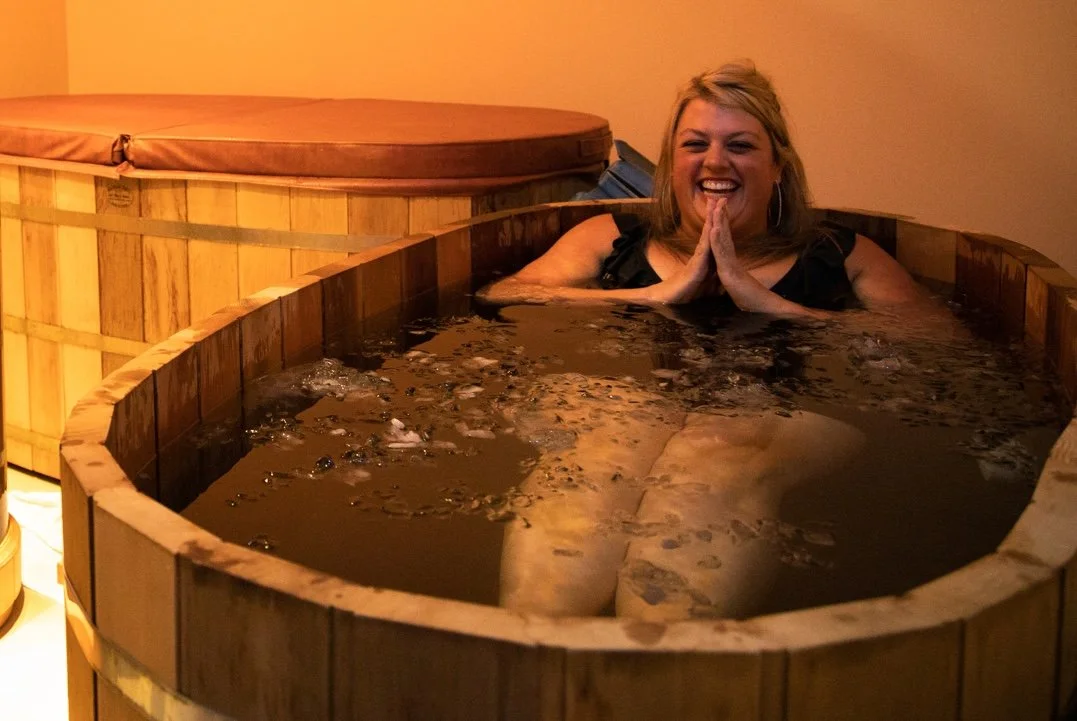
How Contrast Therapy Reboots Your Nervous System (And Why It's the Recovery Trend of 2026)
You know that wired-but-tired feeling? The one where your brain won't turn off, your shoulders live somewhere near your ears, and even a full night's sleep doesn't quite cut it?
That's not just "being stressed." That's your nervous system running on fumes.
And if you've been feeling it more than usual lately — especially as we grind through the tail end of winter — you're not imagining things.
Experts are calling nervous system exhaustion one of the biggest wellness challenges of 2026, and it's something that recovery modalities like contrast therapy are uniquely equipped to address.
Here's what's actually happening in your body, and how alternating between hot and cold can help you reset.
Your Nervous System Is Stuck in "On" Mode
Your autonomic nervous system has two main gears:
Sympathetic — your "fight or flight" response. Heart rate up, adrenaline flowing, muscles tense. Great for dodging danger. Not great when it's running 24/7 because of deadlines, doomscrolling, and a never-ending to-do list.
Parasympathetic — your "rest and digest" mode. This is where healing happens. Recovery. Clarity. Deep sleep.
The problem is that most of us are stuck in sympathetic mode way more often than we should be. And when your nervous system can't shift gears, everything suffers: your sleep, your focus, your mood, even your immune system.
The goal of nervous system reboots is to to teach your body how to shift between stress and recovery more effectively, not eliminate stress altogether.
How Contrast Therapy Trains Your Nervous System to Reset
Contrast therapy — alternating between heat (like an infrared sauna or hot tub) and cold (like a cold plunge) trains your autonomic nervous system to toggle between states.
Here's how it works:
1. Heat Activates Your Relaxation Response
When you step into an infrared sauna, your body temperature rises and blood vessels dilate. Your heart rate gently increases, circulation improves, and your parasympathetic nervous system starts to engage. Muscles relax. Tension starts to melt.
Infrared saunas are particularly effective because they warm your body directly at a lower, more comfortable temperature than traditional saunas, so you get the deep benefits of heat therapy without feeling like you're being cooked.
2. Cold Triggers a Controlled Stress Response
Then comes the cold plunge. Your body encounters a short, intense physical stressor — blood vessels constrict, your heart rate spikes briefly, and your sympathetic nervous system fires up. But here's the key: it's a controlled stressor with a clear end point.
This is what researchers call hormesis — a small dose of stress that makes your system stronger. Cold exposure has been shown to increase dopamine levels by up to 250%, which explains that rush of clarity and focus people feel after a plunge.
3. The Alternation Is Where the Magic Happens
By going back and forth between hot and cold, you're essentially giving your nervous system reps. You're training it to activate, then recover. Stress, then release. Over time, this improves your body's ability to regulate itself.
We end up with better stress resilience, improved circulation, reduced inflammation, and a nervous system that actually knows how to downshift when the day is done.
Why This Matters Right Now
The timing isn't a coincidence. According to the Global Wellness Summit's 2026 trends report, nervous system exhaustion is one of the major wellness crises being addressed this year. Multiple industry experts are pointing to contrast therapy, cold plunge, and heat therapy as go-to recovery tools for anyone whose body has been running on stress for too long, not just athletes.
At the same time, there's a growing backlash against the "optimize everything" mindset. The wellness conversation in 2026 is shifting toward recovery, rest, and repair, which is something we've believed in at Flow Spa from the start. Recovery is one of the most powerful things you can do for your performance, clarity, and overall well-being.
How to Get The Most Out Of a Contrast Therapy Session at Flow Spa
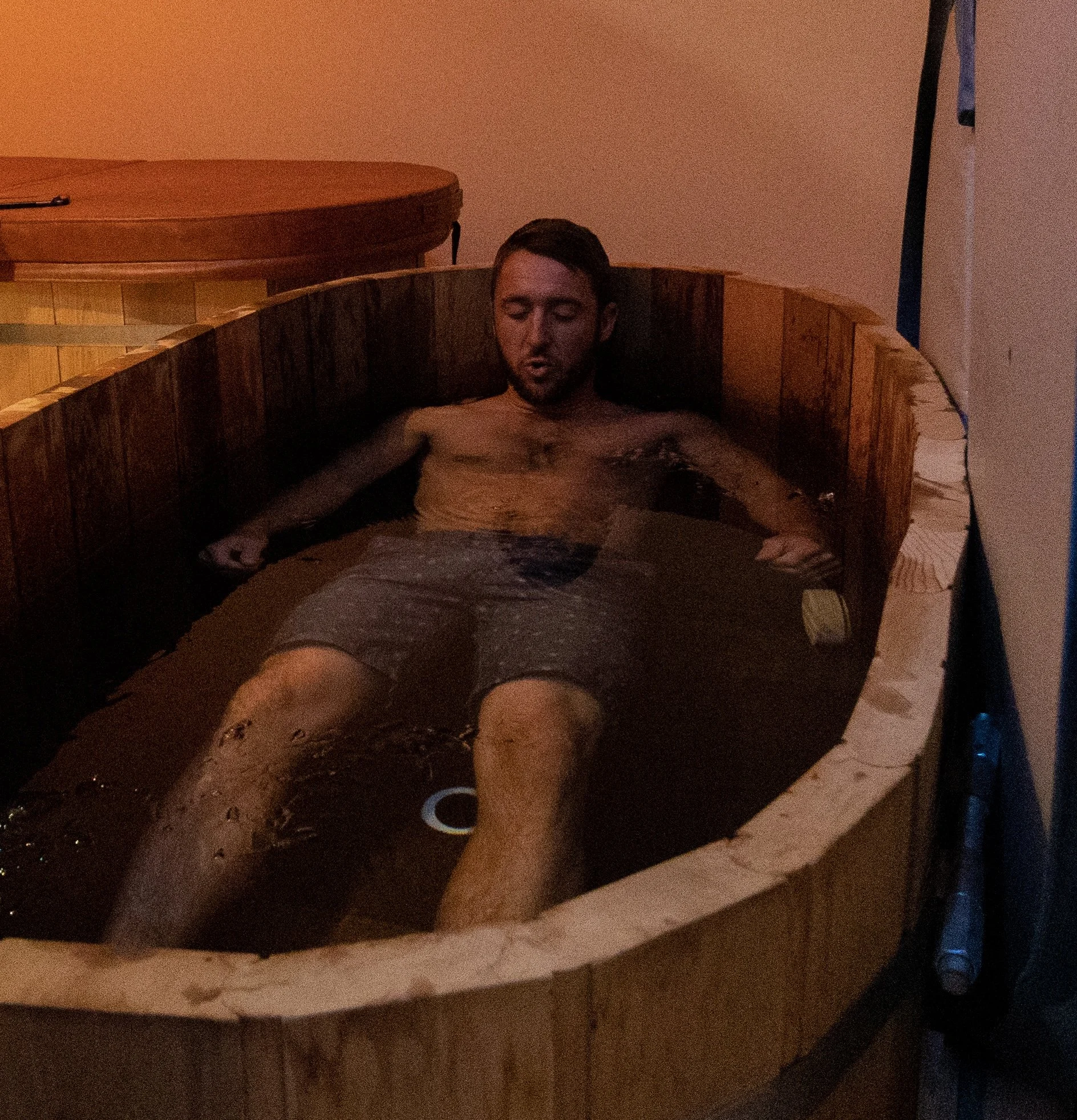
Our contrast therapy sessions in Peterborough give you access to an infrared sauna, hot tub, and cold plunge all in one private room.
Here's the approach we recommend:
Start with the infrared sauna for 15–20 minutes to relax into the experience
Alternate between hot and cold using a 1:2 ratio (e.g., 1 minute hot, 2 minutes cold)
Finish on cold for that dopamine boost and nervous system reset
Rest afterward — let your body integrate the experience
The general recommendation for weekly dosing is at least 11 minutes of cold exposure and 1 hour of heat per week. Our 1-person or 2-person contrast therapy sessions make it easy to hit those targets.
Pro tip: Pair your contrast session with a float for the ultimate nervous system reset. The sensory deprivation environment lets your parasympathetic nervous system fully engage and gives your brain permission to finally stop processing.
Frequently Asked Questions
What is contrast therapy?
Contrast therapy involves alternating between hot and cold temperatures — typically using a sauna or hot tub and a cold plunge pool. The alternation enhances circulation, reduces inflammation, and helps regulate your nervous system.
Is contrast therapy safe for beginners?
Yes. At Flow Spa, you can customize the cold plunge temperature to your comfort level. Most beginners start around 45–50°F and work their way down. Our team will walk you through the process on your first visit.
How often should I do contrast therapy?
For noticeable benefits, aim for at least one session per week. Many of our regular clients come in weekly or biweekly as part of their recovery routine.
What's the difference between contrast therapy and just using a sauna?
While infrared sauna alone offers great benefits for relaxation and circulation, the alternation between hot and cold creates a more dynamic circulatory effect and actively trains your nervous system to shift between activation and recovery.
Can contrast therapy help with anxiety and stress?
Many people report significant improvements in stress levels, mood, and sleep quality with regular contrast therapy. The combination of heat, cold exposure, and the resulting dopamine release can help your body break out of chronic stress patterns.
Where can I try contrast therapy in Peterborough?
Flow Spa offers private contrast therapy sessions with infrared sauna, hot tub, and cold plunge. Book your session online or visit us to learn more.

3 Ways To Make Your Recovery Time More Productive (Without Turning Rest Into Another Job)
Let’s get one thing clear: recovery isn’t always supposed to be productive.
Sometimes the most effective thing you can do is rest, unplug, and let your system settle.
But life isn’t always that perfectly timed.
You’ve got work to do, decisions to make, and a brain that won’t stop running multiple tabs in the background.
So if you’re in a season where you want to feel more efficient without skipping recovery, this is for you.
Below are a few Flow Spa-friendly ways to make recovery time work for you, without turning it into hustle culture in a bathrobe.
The idea behind productive recovery
Productive recovery isn’t about squeezing output from every minute. It’s about pairing recovery with the right kind of tasks.
Think of it like this:
Some tasks require energy, stimulation, and momentum (brainstorming, pitching, complex problem-solving).
Other tasks require space (planning, reflecting, prioritizing, processing, writing, admin).
And some tasks are best when you’re forced to slow down (answering emails, reviewing notes, reading, light creative work).
The trick is choosing recovery modalities that naturally support the mental state you want.
At Flow Spa, we see it all the time: someone comes in stressed, leaves calmer and suddenly the problem they’ve been stuck on feels simple.
So, how do you intentionally create that?
Let’s break it down.
1) Take meetings in the sauna
Why meet at a busy coffee shop when you can meet in a private, quiet space where you’re both getting something back?
Heat changes the tone. People soften. Conversations get real. You’re not performing. You’re not distracted by noise. You’re present.
And if you’ve watched a mobster movie (or The Sopranos), you already know:
Important business happens in the sauna at bath houses.
Why sauna meetings work so well
A sauna has a way of stripping away the unnecessary stuff. You’re not checking your phone every 30 seconds or having it go off and interrupt the meeting. You’re not multitasking. You’re sitting with someone and talking like a human again.
A few things tend to happen naturally:
The conversation gets more honest, faster
People listen more closely
You make decisions with less noise and less ego
Add contrast therapy for even better results
If you really want to upgrade the reset, add contrast therapy. The rhythm of rounds of hot and cold gives the meeting structure:
Round 1: Settle in + catch up
Round 2: What are we actually here to solve?
Round 3: Decide + leave with clear next steps
It’s hard to stay vague when you’ve only got a few rounds.
A few sauna meeting best practices
If you want this to feel amazing and not awkward, keep it simple:
Keep it small: 2 people is ideal.
Keep it light: This is best for alignment, planning, and real talk, not high-pressure negotiations.
Agree on the vibe: Let’s do 2–3 rounds and keep it casual.
Bring water: Hydration matters (and makes the whole session feel better).
Have a plan: One main topic. One desired outcome. That’s it.
We actually see these business meetings happen quite regularly in the private setting we’ve got for our sauna and cold plunge room. Plus, you get to use your visit as a business expense!
2) Get focused work done while using Normatec
If you’re the kind of person who struggles to sit still, Normatec might be your secret weapon.
When you’ve got the leg or hip attachments on, you’ve basically created a built-in focus block:
30–60 minutes where you can’t wander off and start three other tasks.
Why Normatec is surprisingly great for productivity
It’s low stimulation. You’re comfortable. You’re stationary. You’re not in recovery mode in a way that makes you sleepy, you’re just contained.
That’s perfect for:
Emails and admin
Scheduling and planning
Reviewing notes
Editing writing
Reading and learning
Light creative work (outlines, ideas, scripting)
The key: don’t bring your whole life with you
If you bring ten tasks, you’ll do none of them. Stick to one lane.
Try one of these simple setups:
Admin Sprint: invoices, scheduling, replies
Planning Sprint: weekly plan, priorities, calendar cleanup
Creative Sprint: outline a blog post, write headlines, draft a section
Learning Sprint: read, take notes, listen to something educational
A simple Normatec focus formula
Pick one task before you arrive
Put your phone on Do Not Disturb
Set a timer (even if you’re already booked for 30 or 60 minutes)
Work in one clean block
Leave yourself a quick note at the end: “Next step is ____”
You’ll walk out feeling recovered and like you actually moved something forward.
3) Deep thinking and problem-solving in the float tank
There’s no place quite like the float tank for untangling your own mind.
When you remove light, sound, and distraction, something changes: your brain finally has room to process. You stop reacting to inputs and start hearing what’s underneath.
This is why floats can be so powerful for:
Big decisions
Mental overload
Emotional processing
Creative problem-solving
Reconnecting with intuition and clarity
Why float clarity hits different
Most of the time, we’re trying to think clearly while surrounded by noise—notifications, conversations, obligations, background stress.
In the float, the noise drops away. And when it does, you tap into:
what you actually feel
what you actually want
what matters (and what doesn’t)
Often, the answer you’ve been chasing shows up when you stop forcing it.
How to use a float for deep thinking
If you go in trying to aggressively solve a problem, it can backfire. The best approach is to find a state of gentle focus.
Here are a few ways to guide your float:
Option A: One question
Choose one question and bring it in softly. Examples:
“What’s the next right step?”
“What am I avoiding?”
“What would this look like if it was easier?”
“What matters most right now?”
Option B: The mental declutter
Let your mind run at first. Let the thoughts surface. Your only job is to notice them without gripping them.
Often, after 10–20 minutes, the mind quiets and the useful insight emerges.
Option C: Emotional processing
If you’ve been carrying something heavy, the float can be a safe and private container to feel it fully without distractions.
Not dramatic. Just honest.
Post-float integration
A lot of people have great insights… and then lose them in the parking lot or before they’ve even left the room.
If you want the clarity to stick:
Take 2 minutes after your float to jot down notes (even rough ones)
Write the simplest takeaway: “The decision is ____” or “The next step is ____”
If it’s emotional: name what came up and what you need
The physical benefits of floating are incredible. The mental benefits can be profound.
How to choose the right productive recovery option
If you’re not sure where to start, match the service to the outcome you want:
Choose sauna / contrast therapy if you want…
connection and conversation
a nervous system reset that helps you feel more grounded
a structured round-based session that supports decision-making
Choose Normatec if you want…
focused admin time
a contained work block
physical recovery while staying mentally alert
Choose floating if you want…
clarity on a big decision
emotional processing
deep nervous system downshifting and mental quiet
3 sample productive recovery routines
Want something plug-and-play?
Try one of these:
The Busy Week Reset (45–60 minutes)
Normatec session
One admin or planning task only
Leave with a written next step
The Couples / Business Alignment Session (60 minutes)
Sauna + contrast rounds
One main topic
End with: “Here’s what we decided” + 2–3 action items
The Clarity Session (60 minutes)
Float
Bring one question
Write down the answer afterward before you re-enter the world
Your next step
If you’ve been feeling like you don’t have time to recover… this is your permission slip to do it anyway.
And if you want recovery that also creates momentum, try pairing your next visit with one of the strategies above:
Sauna / contrast for connection + real conversation
Normatec for focused, quiet productivity
Float for deeper clarity and processing
Whenever you’re ready, book your next reset and let recovery do what it does best.
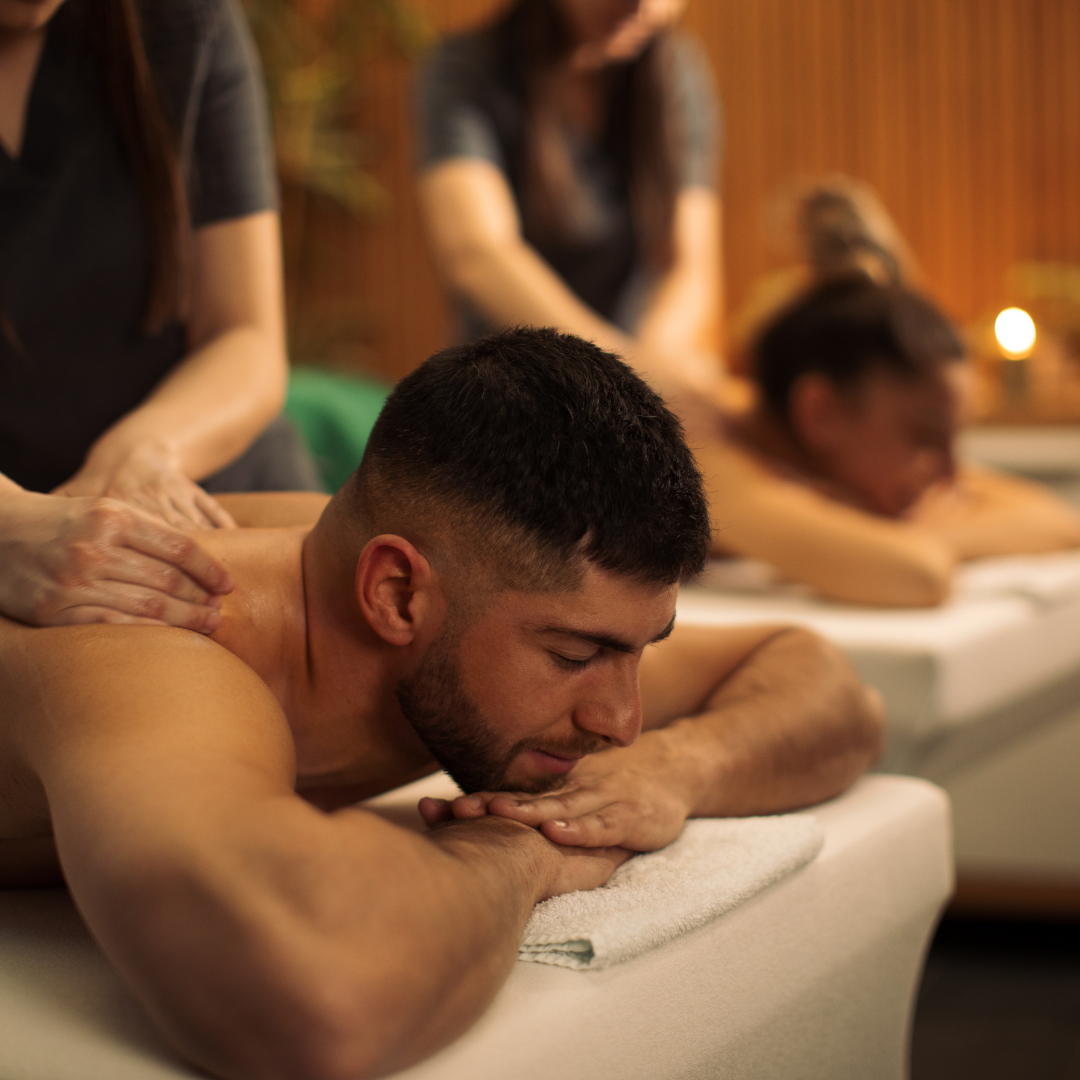
Couple’s Massage in Peterborough: Relax at the Same Time, in Your Own Space
Sometimes, the best date night isn’t dinner and a movie.
It’s quiet.
It’s calm.
It’s leaving the world outside for an hour and giving your nervous system a reset.
That’s why more couples are searching for a couple’s massage in Peterborough, not just as a treat, but as a way to reconnect when life gets busy.
At Flow Spa, our couple’s massage experience allows you to book at the same time, in separate rooms - so each of you gets a fully personalized, deeply relaxing session without distractions.
And if scheduling two therapists at once is tricky? We also offer another perfect pairing: massage + float, where you and your partner alternate so you both get a high-quality experience in one visit.
What Couple’s Massage Means at Flow Spa
When most people hear couple’s massage, they picture two massage tables in the same room.
But here’s the truth: the reason couples book this isn’t because they need to be side-by-side.
It’s because they want:
Time to slow down
A shared moment of care
Relief from stress and tension
A reset they can feel together, afterward
At Flow Spa, a couple’s massage means:
Same appointment time (when available)
Two private treatment rooms
One therapist per person
A calm, boutique experience built around relaxation
You arrive together, relax at the same time, and leave feeling better, without needing to share the room to share the experience.
Why Many Couples Prefer Separate Rooms
This is the part that often surprises people: once couples try it, many actually prefer separate rooms.
1) You relax more deeply
In your own room, it’s easier to fully let go. There’s no awareness of someone else shifting, breathing differently, or wondering if they’re comfortable. You can simply drop in.
2) Your massage is fully personalized
Couples rarely want the exact same thing.
One person might want:
deeper pressure on shoulders and back
focused work for tension or tightness
The other might want:
lighter pressure
a calming, relaxation-forward massage
Separate rooms allow your therapist to tailor the session entirely to you, without compromise.
3) It still feels like a shared experience
The together part happens naturally:
arriving as a team
choosing rest at the same time
reconnecting afterward when you both feel calmer to sit in the infrared sauna together or carry on with your day
A lot of couples tell us the best part is what happens after: the quieter mind, the easier conversation, the feeling of being more present with each other.
A Boutique Experience Without the Assembly Line Feeling
When people are comparing massage options, they’re often comparing more than pricing. They’re comparing how the experience feels.
Some places are built for volume: fast turnover, standard routines, a busy front desk energy. That can be fine if all you need is a massage.
But if you’re booking a couple’s massage in Peterborough because the two of you want it to feel like a real reset, the details matter:
a calm environment instead of a loud lobby
a slower, more grounded pace
a session that feels personal, not procedural
genuine flexibility when scheduling gets complicated
That’s what we aim for at Flow Spa: quality, calm, and care, from start to finish.
What If Two Therapists Aren’t Available at the Same Time?
This comes up often, especially around weekends, holidays, and last-minute bookings.
Here’s the good news: you still have an amazing option that many couples end up loving just as much as both massages at the same time.
The Massage + Float Pairing (Perfect for Couples)
If two therapists aren’t available at once, you and your partner can pair your visit like this:
One person starts with a massage
The other starts with a float session
Then you switch
It’s simple, seamless, and still feels like a shared wellness experience, because you’re both doing something restorative in the same visit.
Even better, we offer combo pricing when booking multiple services in a visit, so you’ll get $20 off each float appointment when booked with a massage, and $10 off sauna sessions. We’ll take care of this automatically for you!
Why couples love this option
No waiting around while your partner is in session
No compromise on quality (each experience gets full attention)
Two different kinds of nervous system reset
Great for couples with different preferences—some people love floating, others prefer massage first
If your schedules are tight, this can also be easier to book than two massages at the exact same time.
What to Expect When You Book a Couple’s Massage
If you’ve never done this before, here’s how it usually feels:
1) Book online or give us a call
It’s easy to schedule a time that matches your preference for massages and other services. If it’s your first time visiting us for a massage, we’ll send you health history forms to fill out.
2) You arrive together and settle in
Take a breath. Let the day go. You’re here now.
3) You head to separate rooms
This is where the real relaxation starts. Quiet. Private. Yours.
4) Each of you checks in with your therapist
You’ll share any preferences—pressure level, areas of tension, and what kind of experience you want (relaxation-focused, more targeted work, etc.).
5) You finish and reconnect afterward
You’ll often notice it immediately—your shoulders lower, your breath slows down, your mind feels quieter. You can meet up again before heading into floats or a sauna session together. And it’s common to feel more connected after, because you’re both regulated at the same time.
Who This Kind of Couple’s Massage Is Perfect For
This experience tends to be a great fit if:
you want a shared reset
you and your partner prefer different pressures or styles
one (or both) of you is new to massage
you value privacy and deep relaxation
you’re trying to book around limited availability
you’d love to pair it with floating or an infrared sauna for a full-body calm
Is It Still a Couple’s Massage If You’re Not in the Same Room?
Yes, because the point isn’t the room setup.
It’s the intention.
You’re choosing rest together. You’re prioritizing wellness together. And you’re giving yourselves an experience that helps you feel better—not just physically, but emotionally.
For a lot of couples, that’s the most romantic thing you can do: creating space to feel like yourselves again.
How to Choose the Best Couple’s Massage in Peterborough
If you’re comparing options, here are a few things worth checking before you book:
Can you book at the same time, even if rooms are separate?
Do they provide a clear explanation of how the experience works?
Is the environment designed for calm, or designed for speed?
Do they offer flexible options and combo discounts on other services like massage + float or massage + sauna?
Do you feel supported in booking, or rushed through it?
The best couple’s massage experience should feel like it was built for real humans with real schedule, not just a rigid system.
Want to Surprise Your Partner? Gift Cards Make It Easy.
If you’re looking for a thoughtful gift that actually gets used, couple’s experiences are hard to beat.
A couple’s massage (or massage + float pairing) works beautifully for:
birthdays
anniversaries
Valentine’s Day
“we need a reset” moments
or simply surprising your partner with something that feels meaningful
We have created specific gift cards for our most popular couple’s packages, so you can give the experience now and let them choose the timing later.
Book Your Couple’s Massage in Peterborough
If you’re ready for a calmer kind of quality time, we’d love to take care of you.
You can book online anytime, and if you’d like help coordinating timing (or exploring a massage + float + sauna pairing), we’re happy to guide you.
Prefer to book by phone? Call us at 705-230-8575
Want to surprise your partner? Gift cards for couples’ packages are available.
FAQs: Couple’s Massage in Peterborough
1) Are we in the same room for a couple’s massage?
At Flow Spa, couple’s massage appointments happen at the same time in separate private rooms, each with your own therapist. Many couples prefer this because it allows for deeper relaxation and a fully personalized session.
2) Can we book our couple’s massage at the same time?
Yes — when two therapists are available, you can book same-time appointments so you and your partner relax at the same time.
3) What if two therapists aren’t available at the same time?
You can still enjoy a shared visit by pairing massage + float. One person starts with a massage while the other floats, then you switch — so you’re both doing something restorative during the same appointment window.
4) Is it still considered a couple’s massage if we’re in separate rooms?
Yes. A couple’s massage is about a shared wellness experience — booking together, relaxing at the same time (or in the same visit), and leaving feeling calmer and more connected.
5) Do we get different therapists?
Yes. Each person has their own therapist, which allows you to choose pressure and focus areas that match your body and preferences.
6) Can we request different pressure levels?
Absolutely. One partner can choose light, relaxation-focused pressure while the other prefers deeper work. Your therapist will adjust pressure throughout the session based on your comfort.
7) What should we wear to a couple’s massage?
Wear whatever is comfortable. You’ll have privacy to change, and you’ll be properly draped during the massage. We also provide bath robes for you to go from one room to the next if you’re booking multiple services.
8) How long should we book for a couple’s massage?
A 60-minute session is a great start. If you want a more unhurried, deeper reset, consider 75–90 minutes. Some couples also like to book shorter massage appointments when pairing it with additional services, like a 30-minute float or 30-minute infrared sauna session after.
9) How do we book a couple’s massage at Flow Spa?
You can book online, or call 705-230-8575 if you’d like help choosing times, coordinating two therapists, or setting up a massage + float pairing.

New Year Reset in Peterborough: Float, Sauna & Cold Plunge
New year, fresh start… and somehow your nervous system still feels like it’s running on last year’s battery.
If you’ve ever tried to turn your life around on January 1st (new routine, new diet, new everything), you already know how this goes: it works for a week or two… then real life shows up again.
So let’s make this easier.
This post is about building a simple recovery ritual—one you can actually maintain— and picking what works right for you to support all your other goals in the New Year.
Why most New Year plans fail (and what to do instead)
Most resolutions break for one reason: they demand too much willpower.
When you’re stressed, under-slept, overworked, and your calendar is already full, adding more pressure doesn’t help. What helps is a base layer habit that makes everything else easier.
That’s what good recovery is.
When your body and brain are less depleted, you:
make better decisions
handle stress with more patience
sleep deeper
bounce back faster from workouts and busy weeks
So instead of a complicated plan, we’re aiming for a repeatable reset each week. It’s central to what’s known as the Reverse Productivity Method.
Instead of staring at your calendar each week and cramming in as much work as you can, you start by scheduling 1 or 2 blocks per week of recovery time that’s safeguarded against the rest of your busy schedule.
The New Year Reset Ritual
If you only do one thing this month, do this:
Try A Weekly Reset (30–60 minutes)
Float therapy (60 minutes) for deep calm and nervous system downshifting
OR
Contrast therapy (sauna + hot tub and cold plunge cycles) for energy + recovery
OR
Infrared sauna (30 minutes) solo when you want something gentle, warm, and grounding
Not every reset needs to happen at the spa.
Here are three simple practices you can layer in at home to support your recovery and try out:
1. The 4-7-8 Breath (2 minutes, anytime)
Breathe in through your nose for 4 counts, hold for 7, exhale slowly through your mouth for 8. Do this for 3–4 rounds when you notice tension building—before bed, after a stressful call, or between tasks. It's one of the fastest ways to downshift your nervous system without changing your environment. It also works well to extend this relaxation into a longer 10-20 minute meditation block once you’ve down-regulated.
2. Morning Sunlight Walk (10 minutes, ideally before 10 AM)
Step outside within an hour of waking and walk for 10 minutes. No podcast, no agenda. Just movement and daylight. This helps anchor your circadian rhythm, supports mood regulation, and gives your brain a low-stimulation reset before the day ramps up. Yes, even in January.
3. Evening Wind-Down Routine (15 minutes, before bed)
Dim the lights. Put your phone in another room. Do something analog: stretch on the floor, write three things that went well today, or just sit quietly with tea. Over time extend this wind-down routine for more quiet and peace before bed without the stimulation of your phone or TV.
These practices won't replace a float or sauna session, but they help you carry the benefits forward. Think of them as the "glue" that makes your recovery ritual stick.
Instead of trying to find perfect consistency, look to build your routine around something you’ll actually return to.
Why float therapy works so well for a reset
Less noise, less gravity, less stimulation**.** Your body stops bracing. Your mind gets a break from input.
Research in clinical settings has found floating or what researchers call “floatation-REST” to be feasible, well-tolerated, and safe in people with anxiety and depression, with participants reporting positively-valenced experiences. This means that even for people with anxiety or depression (and often more so), the experience of float therapy helps to shift us to a more positive state.
There’s also research showing floatation can reliably shift subjective experience of our surroundings (time distortion, softened body boundaries), which lines up with why people often describe floating as a “brain reset.”
And broader reviews suggest floatation-REST may support reductions in anxiety and improvements in sleep and pain.
In plain English: floating creates the conditions for your system to finally and fully exhale.
Float is perfect when you want:
stress relief and nervous system downshift
deep mental quiet (no screens, no notifications)
recovery when you feel wired but tired
a clean slate feeling after a heavy season
(If you want a deeper read, check out how Floating can support your New Year’s Resolutions here.)
Why infrared sauna is a winter superpower
Infrared sauna is one of the easiest ways to give your body a warm, restorative stimulus without needing motivation or intensity.
There’s a growing body of research on sauna bathing and other heat therapy like hot tubs for cardiovascular and vascular function, with reviews describing mechanisms like improved endothelial function and circulation-related benefits.
Sitting in the sauna shines because it’s simple:
you warm up
you breathe
you sweat
you leave feeling looser and calmer
Sauna is perfect when you want:
gentle recovery (especially in winter)
decompression without doing more
a warm mood boost
mobility + muscle relaxation
Cold plunge and contrast therapy: the “switch flip” reset
Cold plunging gets a lot of hype. Some of it is deserved… and some of it needs context.
A 2025 systematic review in PLOS One suggests cold water immersion may have time-dependent effects across inflammation, stress, sleep quality, and quality of life—while also noting the evidence base has limitations.
And importantly, cold exposure isn’t always good for everyone. Credible medical sources emphasize moderation and risk awareness (hypothermia, overexposure, and individual health considerations).
Professional organizations also list common contraindications to consider (e.g., certain cardiovascular conditions, Raynaud’s, uncontrolled hypertension).
Where contrast therapy is a sweet spot
Contrast therapy (alternating hot and cold) gives you the benefits of both ends:
heat to relax and open up
cold to sharpen and reset
There’s research showing heat/cold influences tissue perfusion, and contrast protocols can produce more significant and longer-lasting effects on microcirculation measures than either heat or cold alone (in certain settings).
Contrast is perfect when you want:
an energizing mood shift
workout recovery support
a mentally sharp + physically loose feeling
a ritual that feels like a full system reboot
Pick your reset based on how you feel right now
If you feel overstimulated, anxious, or burnt out:
Choose: Float Therapy
Less input = more recovery bandwidth
If you feel tense, tight, and winter-stiff:
Choose: Infrared sauna
Gentle heat + loosen + breathe
If you feel flat, sluggish, or stuck in a fog:
Choose: Contrast therapy
Hot/cold alternation = “switch flip” energy
You don’t need a perfect routine. Try this:
Pick one anchor session at Flow Spa this week (float OR contrast OR sauna).
Add two micro-resets at home:
4-7-8 Breathing before bed
10-minute walk outside
That’s it. If you nail the anchor session weekly, your whole month improves.
What to expect for your first visit
You don’t need to be good at relaxing. That’s the whole point of what we provide for you.
Start with what feels doable (sauna-only for half an hour is a great entry point).
Ready to build your 2026 recovery ritual?
If your goal this year is to feel calmer, more energized, and more resilient, start by protecting your recovery.
Book your session at Flow Spa
Float Therapy
Infrared Sauna
Cold Plunge & Contrast Therapy
Massage Therapy & Psychotherapy (great complements to a reset routine)
The Flow Spa Holiday Wellness Guide (2025): How to Stay Calm, Grounded & Rested This Season
The Flow Spa Holiday Wellness Guide: How to Stay Calm, Grounded & Rested This Season
The holidays are supposed to feel magical, but in reality, they often hit more like a sprint. Between shopping, social plans, family dynamics, and year-end pressure at work, your nervous system gets pulled in every direction.
So, how do you stay grounded when the season gets chaotic?
We’ve put this guide together just for that!
Below you’ll find simple, science-backed ways to protect your energy, boost your mood, and carve out real moments of calm. And when you want deeper restoration, we’ve included our Holiday Sale details for this December at the end.
Let’s get into it.
Understand Why the Holidays Feel Overwhelming
Our stress response ramps up for a lot of us in December.
A few things happen all at once this time of year:
More stimulation (lights, noise, social events)
Less routine (sleep, meals, movement)
More obligations (planning, coordinating, gifting)
Colder, darker days that naturally lower mood, motivation and energy
Your nervous system isn’t built for nonstop “on” mode, even though that’s what most of us throw at it as the year comes to a close. It needs moments of stillness to reset; otherwise, everything starts to feel more demanding.
That’s why intentional recovery becomes essential this time of year.
Build Your Daily Holiday Reset
A full wellness routine is often too much for most of us to stick to in the final few weeks before the holidays.
Instead, start with quick, nervous-system-friendly resets you can sprinkle throughout your day.
Try one of these:
4-7-8 Breathing (1 minute)
Inhale 4 → hold 7 → exhale 8 → inhale 4.
Shown to reduce anxiety. It’s like hitting a manual calm button.
Hot-Cold Contrast in the Shower (30 seconds)
End your shower with 15 seconds cold → 15 seconds warm. The water coming out of the tap is icy cold this time of year.
Helps energize your morning and improve circulation.
Light Exposure Break (2 minutes)
Step outside, even on cloudy days. Natural light stabilizes your mood and circadian rhythm.
Lowering the Shoulders Technique (10 seconds)
Drop your shoulders down. Breathe. Notice how much tension you were subconsciously holding.
These micro resets help your body shift out of stress mode, so you feel more grounded and can carry on with the rest of your day.
Create a Winter Mood Ritual
December is the perfect time to build a small routine that gently boosts your mood.
Think of it as your personal winter anchor.
Here are a few ideas:
Morning heat ritual: Any warm drink + 3 slow breaths (or crank up the heat with some fire breathing and a minute or arm pumps or jumping jacks)
Evening wind-down: 5-minute journal to settle the day + dim lighting
Movement snack: A 10-minute walk after lunch
Sensory break: A quiet, phone-free half hour before bed
Consistency matters more than intensity. Healthy habits take time to have lasting benefits. A tiny ritual repeated daily builds emotional resilience through the busiest time of year.
Why Float Therapy Helps You Reset Faster in December
When your system is overstimulated, the best thing you can do is give it a break from… well, everything.
That’s why floating works so well during the holidays and cold winter months.
Inside the float tank, your body gets:
Zero sensory input (up to you based on what you’re comfortable with)
No noise, no light, no pressure on your joints.
Deep relaxation
Magnesium-rich water helps ease tense muscles and improve sleep.
A neurological reset
Brain activity slows down, allowing you to drop into a restorative state. This works even for the most hyperactive of minds.
For many people, a 60-minute float feels like pressing restart on the nervous system. There’s no better feeling than that when your mind is being pulled in a thousand directions.
Warmth Therapy: Your Winter Mood Booster
Sauna and heat therapy are the perfect companions to floating this time of year. Research shows that heat exposure can help:
Improve circulation
Boost mood (thanks to endorphins)
Ease muscle stiffness from cold weather
Support deeper sleep
A session in the infrared sauna or a hot-cold contrast therapy circuit does wonders when your body feels sluggish, tired, or tense.
Give the Gift of Calm (Even to Yourself)
More people are choosing experiences over more stuff, and for good reason.
Experiences:
Create stronger memories
Improve mood longer
Reduce stress
Bring people closer together
A float, sauna session, or massage gift card gives someone something they rarely give themselves: permission to truly rest.
(It also solves the “I have no idea what to get them” problem instantly.)
Flow Spa’s Holiday Sale Is On
To help you (and the people you care about) get through the season feeling calm, grounded, and restored, we’ve launched our Holiday Sale.
🎁 Special Holiday Packages Include:
Up to 20% off Gift Card
Float + Sauna Bundles
Contrast Therapy Packages
Relaxation-focused gift card packages
Limited-edition holiday couple’s experiences
They’re available throughout the month of December, and they’re designed to make seasonal stress a little easier to manage.
If you’re ready to give the gift of calm — or keep it for yourself — now’s the perfect time.
Protect Your Peace This Season
The holidays can be beautiful, but they’re also demanding.
So take a breath. Slow down. Build little rituals that support you. And when you’re ready for a deeper reset, the team at Flow Spa is here to help you come back to yourself.

From Party Mode to Recovery Mode: Why Your Next Night Out Should Be a Spa Night (or Spa Day) at Flow Spa
For a long time, going out meant late nights, loud music, and waking up the next day feeling less than amazing.
More people are starting to ask a different question:
What if your night out actually left you feeling better the next day?
That’s where the idea of a spa night or spa day out comes in—trading hangovers for deep sleep, stress for calm, and small talk for real connection. And with Flow Spa’s new capacity for two massage therapists working simultaneously, it’s now easier than ever for 2–3 people to come in together for a shared reset.
Why Spa Night Out Is Replacing Going Out For Many People
There’s a growing shift toward experiences that support:
Recovery instead of burnout
Presence instead of distraction
Connection instead of noise
Instead of shouting over music, you’re stepping into a calm space where your nervous system can actually relax. Instead of spending money on drinks you forget, you’re investing in a reset your body and mind will feel for days.
A spa night or spa day out at Flow Spa is perfect for:
Couples who want something deeper than dinner and drinks
Friends who want to reconnect without the next-day crash
Busy professionals who need a reset ritual that actually moves the needle on stress and sleep
What a Flow Spa Night (or Day) Out Can Look Like
Because we now have two massage therapists available at once, we can host small groups of 2–4 people for shared experiences that still feel personalized.
Here are a few sample “party to recovery” itineraries you can use as packages or inspiration:
Note - we can change the order of treatments based on your preferences, and depending on RMT availability.
“What a wonderful experience at Flow Spa! RJ was incredibly helpful in booking a morning for myself and two friends. We each had a massage and float session and enough time to enjoy the sauna too. The timing worked out beautifully. Best massage ever from Olivia.
Thanks for a fantastic time RJ. We will be back.”
1. The Couples Reset: Float + Massage + Contrast Therapy
Perfect for: partners who want to actually feel better after their day date.
A sample flow:
Arrive and decompress
Check in, change, take a few minutes to slow your breathing and let the day drop away.
60-minute float sessions
Calm the nervous system.
Offload physical tension before massage.
Give your brain rare, quiet, distraction-free space.
Massages at the same time
With two registered massage therapists working in separate treatment rooms, you can both receive personalized bodywork at the same time. You arrive together, unwind together, and finish around the same time, without anyone waiting around while the other gets their massage.
Finish in the contrast therapy room
Rotate between hot and cold in our contrast therapy room to:
Boost circulation
Support recovery
Leave feeling clear-headed and energized, not wiped out
2. The Friends’ Spa Day: Massage + Contrast Therapy + Float
Perfect for: 2–3 friends who want to catch up, unwind, and feel human again.
A sample flow:
Start with contrast therapy together
Use hot-and-cold cycles to:
Shake off the stress of the week
Get those “feel-good” endorphins going
Share a fun, slightly challenging experience that feels more meaningful than another round of drinks
Massages in separate rooms, timed together
With two RMTs working in separate treatment rooms, we can:
Treat two people at the same time
Or, if three people are coming, stagger appointments so that one person is floating or in contrast therapy while the other two are getting massages
This way, everyone stays moving through their own part of the spa day without long gaps or awkward waiting.
End with floats
Finish the night in the quiet of a float session, so you leave grounded, deeply relaxed, and ready for deep sleep.
3. The “Day Off Done Right” Spa Day
Perfect for: small groups taking a weekday off, shift workers, or solo guests who want to join a friend or partner partway through.
A sample sequence:
Late morning: contrast therapy to wake up the body
Midday: 60- or 90-minute massages (two at a time)
Afternoon: floats to lock in the recovery and send you into the rest of the day calm and clear
Why This Beats a Traditional Night Out
A typical night out:
Costs add up on food, drinks, rideshares, and cover charges
Sleep is worse, not better
You wake up the next day dehydrated, inflamed, and behind
A spa night or spa day out at Flow Spa:
Puts your money toward recovery and wellbeing
Improves your sleep and stress levels instead of wrecking them
Strengthens your relationships in a calm, intentional setting
Gives you a story to share, but one your body actually appreciates
Experience Gifts, Packages, and Holiday Gifting
As we head into the holidays, more people are choosing to give experiences over stuff.
At Flow Spa, that’s where our packages and gift cards shine:
Gift cards are perfect when you want the recipient to build their own spa night or spa day.
Spa packages for 2–3 people make ideal gifts for:
Couples
Parents who need a break
Friends who are always “too busy” for self-care
Co-workers or team members who need a serious reset
Each can include a thoughtful combination of:
Floats
Massages
Sauna or Contrast Therapy
For groups of 2–3 people, we’ll schedule everything so your floats and massages line up as a shared experience.
How to Book Your Spa Night or Spa Day at Flow Spa
If you’re looking to book 3-4 people for a spa day experience, give us a call or send an email using the contact form below and we’ll help to coordinate it the best for your party.
Ready to trade the hangover for deep sleep and real recovery?

When Your Nervous System Crashes
Nervous System Crash? Flow Spa’s Recovery Playbook
What to do when your nervous system runs dry
You’ve been in go-mode for weeks—pushing training, meeting deadlines, juggling family life. Then one morning you wake up and there’s nothing left in the tank.
You’re wired yet tired.
Sleep feels light and choppy.
Focus slips.
Motivation is flat.
You try to push through, but your body isn’t buying it.
If this sounds familiar, you’re not broken and you’re not weak. You’re experiencing a nervous system out of balance. It slows down so you don’t burn out.
The good news?
You can help it recalibrate.
Below is a simple, practical plan you can use today, this week, and over the next month to refill your system and get back to feeling like yourself.
Quick self-check: Are you in a “nervous system crash”?
Common signs
Wired-and-tired (amped up but exhausted)
Irritability or shorter fuse than usual
Brain fog and low motivation
Non-refreshing sleep (wake up un-rested)
Elevated resting heart rate compared to your baseline and suppressed HRV
Digestive tension: stomach knots, loss of appetite, or cravings
Red flags that require medical care
Chest pain, fainting, or severe shortness of breath
Thoughts of self-harm
Sudden neurological changes (e.g., weakness, slurred speech)
This article is for informational purposes only and not medical advice. If you’re unsure about anything, consult a healthcare professional.
The simple science
Your body has an “accelerator” (the sympathetic stress response) and a “brake” (the parasympathetic recovery response).
When life piles on—hard training, tight timelines, less sleep—the accelerator can stick. Over time, that lowers your “vagal tone” (how responsive your recovery system is), and you feel it in sleep, digestion, mood, and focus.
Here’s the hopeful part: the recovery side is trainable. With the right inputs, like calm breath, predictable routines, quiet environments, and intentional recovery practices, you send repeated all clear signals to your nervous system.
Consistency brings the brakes back online.
A 15-minute downshift you can do today
Step 1: Breathe (5–10 minutes)
Try 4–6-7 breathing: breathe in for 4, out for 6, hold for 7. If it helps, set a timer and count the exhales.
Step 2: Gentle posture (3–5 minutes)
Legs-up-the-wall or supported child’s pose. The goal is to feel supported, not stretched.
Step 3: Simple refuel (2–3 minutes)
Have a light, protein-forward snack and add electrolytes to your water. Skip late-day caffeine.
Optional: Vagal nudges (60–90 seconds)
Hum, sing softly, or do a gentle gargle—small signals that help the “brakes” engage.
Flow Spa tip: If you can stop by today, a 30-minute Infrared Sauna is a calm, quiet reset that often sets up better sleep tonight.
Build your Weekly Deep Recovery Protocol
Do one “deep reset” each week to turn down your nervous system. Book it like a meeting you can’t miss.
Near-zero sensory input + buoyancy = time where your system doesn’t have to process much at all. You’ll experience deep relaxation and a much quieter brain afterwards.
Gentle heat in a quiet space supports relaxation, circulation, and that post-sauna glow. Pair with a cool rinse to finish.
Hot/cold exposure trains your stress-response to rise and then return to calm.
Note: If you’re in recovery mode, don’t go super-extreme on the cold. Aim for manageable exposure and prioritize how quickly you settle afterward.
Massage Therapy or FST (60–90 min)
Releases physical tension and sends safety signals through pressure and breath cueing. We can tailor pressure, pace, and focus areas to your needs.
How to use it
Pick one anchor weekly: Float, Massage, Sauna, or Contrast.
Add extra supports on the other days of the week: see Daily Ritual Menu
Protect bedtime with a digital sunset: no scrolling for 60 minutes pre-sleep.
Suggested stack: Recovery Reset—over three weeks: 1 Float + 1 Sauna or Contrast + 1 Massage.
Simple, structured, effective.
Your Daily Ritual Menu (choose 1–2, 10–15 minutes)
The goal isn’t to create the perfect routine, just reliable nudges that add up to nervous system recovery.
Breathwork (5–10 min): Slow exhale breathing or box breathing (4-4-4-4).
NSDR / Yoga Nidra (10–20 min): Audio-guided deep rest without sleep.
Morning light (2–10 min): Step outside soon after waking to anchor your body clock.
Nervous-system walk (10–20 min): Easy pace, nasal breathing, no phone.
Vagus tone boosters (1–2 min): Hum a song, sing lightly, or gentle gargle.
Micro-release (3–5 min): Neck, jaw, and shoulder softening with mobility + 6 slow breaths.
Screen hygiene (bookends): Notifications off for the first and last 30 minutes of your day.
Coach’s tip: Habit stack. “After coffee in the morning, I will do 5 minutes of breathing.” Tie the new action to something you already do that’s habitual.
Really depleted? Try this 3-day reset
Day 1: Stop the leak
Cancel non-essentials. Keep movement gentle (walks, mobility, yoga).
Eat simple, protein-forward meals. Improper nutrition can be a stressor as well. Hydrate with electrolytes.
Early night routine.
If you can, book a 30-minute Infrared Sauna or a 60-minute Float.
Day 2: Restore
NSDR or Yoga Nidra mid-day (10–20 min).
Nature walk; keep it conversational pace.
Include magnesium-rich foods (leafy greens, legumes, seeds).
Reduce stimulants after noon.
Schedule Massage Therapy to release lingering tension.
Day 3: Re-entry
Keep an early bedtime.
Add one focused 60–90 minute work block. Don’t jump back into a full sprint.
Book your weekly deep recovery for the next 4 weeks.
Returning to training or high-output work (without relapsing)
The 3-2-1 ramp
Week 1: 3 light sessions (RPE 4–5/10).
Week 2: 2 moderate sessions (RPE 6–7) + 1 light.
Week 3: 1 hard session (RPE 8) + 2 moderate.
Watch these markers
Morning mood, resting HR, HRV (if you track), cravings, and sleep quality.
If you see improvements, keep going.
If sleep or mood dip for 2+ days, step back a week and add more recovery.
Pro tip
Keep your weekly anchor session in place even as you ramp. It prevents the “all gas, no brakes” from sneaking back into your life.
FAQs About Nervous System Crashes
Is this burnout?
Maybe. “Burnout” is a broad term, but what you’re feeling could be the early signs. What matters here is noticing signs of chronic overdrive and giving your system structured recovery. If symptoms are severe or persistent, speak with a healthcare professional.
How often should I float if I’m stressed?
Start with once weekly for 3–4 weeks, then reassess. Many clients maintain bi-weekly or monthly floats as a steady anchor against stress and burnout.
Sauna vs. contrast—how do I choose?
Choose Infrared Sauna if you want calm, steady warmth and a quiet environment. Choose Contrast Therapy if you want exposure that builds stress-resilience and a strong “return to calm.” If you’re very depleted, begin with Sauna first to avoid stressing your nervous system any more.
What if I can’t relax during a massage?
Totally normal. Our RMTs will adjust pressure, pacing, and breath cueing, and keep communication open. Relaxation often builds across a few sessions as your system learns the pattern.
Can I overdo recovery?
You sure can. If recovery becomes another rigid task, it can add stress. More stimulating recovery like deep tissue massage and contrast therapy can also become a stressor itself if too intense. Aim for consistency over intensity: one weekly deep reset + one or two daily rituals is a powerful baseline.
Flow Spa next steps
Book your Recovery Reset: Pick whatever is calling out to you the most, whether it’s a float, massage, sauna, or contrast.
New here? Try the a Float and pair it with a 30-min Infrared Sauna add-on for a gentle, sleep-supportive reset at a discounted rate.
Prefer guidance? Ask us about a 4-week Deep Recovery Plan with simple check-ins and scheduling support.
Ready when you are:
Final word
You don’t need a perfect routine to feel better, you need a reliable one. Anchor one deep reset each week, add one or two daily rituals, and protect your evenings. Your nervous system will get the message: it’s safe to downshift. And when you need a hand, we’re here in Peterborough with quiet rooms, warm saunas, cold plunges, and skilled therapists ready to support your reset.
Beat the Winter Slump: Sauna, Light, and Micro-Habits to Guard Your Mood
The problem with November: less light, less rhythm
Clocks shift, daylight shrinks, and routines wobble as the pressure before Christmas bears down on us.
That dramatic fall-to-winter pivot can nudge sleep later, drain morning energy, and make focus feel slippery.
You’re not imagining that slump — less morning light delays your body clock, evening screens after the sun sets pull you further off schedule, and motivation dips as the days get shorter.
The fix isn’t one heroic habit. It’s a few small, repeatable moves that realign light timing, add restorative heat, and make bedtime feel predictable again.
Below is a simple, battle-tested plan that you can start this week.
Key takeaway: Small habits done at the same times each day beat big efforts done once. From November through February, consistency is the superpower.
Why this plan works
Light sets your clock. Morning daylight (or a 10,000-lux light box if you’re up before the sun and for gloomy days) tells your brain “daytime now,” helping advance sleep earlier and lift daytime alertness. Supporting your circadian rhythm becomes even more crucial during the darker winter months.
Heat calms the system. Gentle infrared sauna sessions can relax muscles, ease stress, and support deeper sleep later that night.
Predictable wind-down cues sleep. A short, repeatable ritual trains your body to power down, like a flight checklist for your nervous system.
Weekly resets keep you honest. A 15-minute Sunday check-in keeps the wheels on: book sessions, place your light box, set out warm layers.
Crosslinks to explore:
• Our 2025 Guide to Infrared Sauna Benefits — why heat helps mood & sleep
• Bedtime Rituals — a 3-step wind-down you’ll actually keep
The 4-Week Anti-Slump Plan
How to use this: Keep what you add. By Week 4, you’ll have a simple system that runs in the background.
Week 1 — Light first, screens last
Morning daylight target: 20–30 minutes within an hour of waking. Outside is best but being near a bright window works better than nothing if the weather’s brutal.
On dark mornings: Use a 10,000-lux light box angled to the side of your eyes for 20–30 minutes while you have coffee or breakfast.
Evening guardrails: Dim lights ~90 minutes before bed. Use less overhead light and more floor or table lamps. Switch your devices to warm/night mode. Keep your bedroom sacred - no doom-scrolling in bed.
Micro-habit anchor: Put the light box exactly where you sit each morning. When trying to lock in a new habit, if it’s in a drawer or closet, it doesn’t exist.
Week 2 — Infrared sauna cadence for mood & sleep
Frequency: 1-2 sessions per week.
Time & temp: Start with 30 minutes once per week at a comfortable temperature setting; increase the temperature as you adapt. At Flow Spa, we use a 65 degree sauna that’s a perfect temperature for benefitting without cooking. It’s easy to regulate by cracking open the door for a few seconds.
Best timing: Late afternoon to early evening to ease tension and prime sleep. If you find it energizing, shift earlier in the day.
Hydration & minerals: Drink water before/after; consider electrolytes on sauna days.
Stack the habit: After each session, take 5 slow breaths with a hand on your belly. Notice shoulders dropping.
Local note: Book two sessions this week at Flow Spa and repeat next week.
Learn more: Infrared Sauna Benefits (2025).
Week 3 — A wind-down ritual that actually sticks (10–15 min)
Step 1: Downshift the senses. Lights low. Optional warm shower or 3 minutes of gentle stretching.
Step 2: Brain dump. On paper, write 3 lines:
What can wait until tomorrow?
What’s the first tiny step I will take tomorrow?
What time will I start?
Step 3: Create a comfort cue. It could be herbal tea, an eye mask on the nightstand, or keep your phone charging outside the bedroom to signal your sleep sanctuary.
Same window nightly: Aim for the same 60-minute window each night, even on weekends. This routine becomes critical during the winter slump.
Week 4 — Sunday reset + winter movement minimums
15-minute Sunday reset:
Pre-book your sauna or float sessions.
Place the light box and your journal where they’re used.
Plan three weeknight dinners (simple wins with good nutrition).
Stage warm layers by the door for making outdoor activity accessible.
Movement floor: 20–30 minutes of easy movement most days (walks absolutely count). Choose a cue: it could be in the morning, after lunch, or right after work.
Contrast for alertness vs. Float for deep calm—when to use which
Contrast therapy (hot ↔ cold):
Use earlier in the day for a clean alertness bump and a brighter mood.
Keep cold exposures brief; finish warm if you’re within a few hours of bedtime to trigger sleep onset.
Great before a focused afternoon of work or to shake off “November fog.”
Float therapy:
Best for deep calm and sensory relief.
Ideal evenings or after high-stress days to quiet mental noise and support better sleep.
Pairs beautifully with Week 3’s wind-down ritual: float → tea → low lights → journal.
Quick chooser:
Need to rally? Try contrast.
Need to unwind? Float.
The winter-makes-it-easier gear list
10,000-lux light box (tabletop).
Warm layers kit: merino base layer, breathable mid-layer, windproof shell, toque, gloves.
Herbal sleep kit: chamomile or lemon balm tea, magnesium glycinate (evening), eye mask, earplugs.
Wind-down props: notebook + pen on the nightstand, low-watt warm bulbs, lamp timer.
Sauna bag: water bottle, small towel, clean cozy layers for afterward.
Pro tip: Put the light box and journal where you already sit in the morning. Reduce friction, increase follow-through.
Safety & practicality notes
New to heat/cold exposure, pregnant, or managing a medical condition? Check with your healthcare provider first.
Start shorter and cooler, and progress gradually. Your body’s feedback beats any rule on the internet.
Stay hydrated. If you feel lightheaded or unwell, stop the session or take a break to rest.
Book an evening sauna/float session
Option A — Sauna Night (45–60 min):
30 minute Infrared Sauna
Quiet cool-down + tea in office
3-line journal to close the loop
Option B — Float Reset (60–90 min):
60 or 90 minutes Float Therapy for sensory relief
Step into dim lights at home and your wind-down ritual
Want the full nervous-system reset? You can pair a full contrast therapy session + float or sauna + float for a discount on the combo appointment.
Optional FAQ
Does infrared sauna help with seasonal mood?
Many people report a calmer mood and easier sleep after consistent sessions. Heat relaxes muscles, promotes a pleasant “post-sauna exhale,” and can help you transition to the evening. As always, go by how you feel and build gradually. (More in our IR Sauna Benefits article.)
When should I use a light box?
Morning is best—within an hour of waking—for 20–30 minutes. Keep the box slightly off to the side of your eyes while you read or sip coffee. Avoid light boxes late at night, which can push your sleep later.
Is contrast therapy safe at night?
Cold can be alerting. If you’re using contrast in the evening, keep cold exposures brief and finish warm, or use sauna-only instead. Getting too cold before bed can disrupt sleep.
How many sauna sessions per week?
A simple target is 1-2 sessions/week. Start with one and adjust based on how you feel.
Can I combine sauna and float on the same day?
Yes. Many guests extend their relaxation and use sauna to downshift the body and float to quiet the mind.
Your next step
Pick your Week 1 habit: morning light and evening dimming.
Book one or two IR sauna sessions for next week to anchor the routine.
Choose one wind-down you’ll keep (tea + journal is plenty).
When you’re ready, we’ll hold the space for your reset.
Book your Winter Mood Block at Flow Spa.
Peterborough’s spot for infrared sauna, contrast therapy, float therapy, massage, and psychotherapy—all under one roof.

Float + Therapy: How to Use Floating to Prime Talk Therapy (and Vice Versa)
If you’ve ever left a therapy session wishing you had more space to let it all settle, or arrived feeling too wound up to talk, pairing float therapy with psychotherapy can change the game.
Sensory reduction lowers the volume on external input so your brain can process what matters, like the important work of a therapy session.
Used together intentionally, floating and talk therapy become a powerful one-two punch for overcoming anxiety, rumination, and creative blocks.
Why sensory reduction prepares the brain for emotional processing
When you float, external stimulation drops. There are no screens, no noise, minimal gravity.
That shift helps:
Down-regulate the stress response. With fewer sensory demands, your nervous system can move from “fight/flight” toward “rest/digest.”
Reduce cognitive load. Less incoming data = more bandwidth for internal awareness (interoception) and memory consolidation.
Increase openness and insight. Many people report easier access to feelings, memories, and connecting the dots after a float.
So, whether you float before therapy to arrive calmer and more open, or after therapy to integrate the work you just did, sensory reduction in the float gives your mind a quieter space to reorganize.
Two pathways that work
Pathway A: Float → Therapy (Prime and open)
Best when anxiety spikes before sessions or you struggle to drop in and open up.
Float (60–90 minutes). Set a single intention: “What feels most important to talk about today?”
Gentle transition (10–20 minutes). Shower, hydrate, jot down 3 words that describe how you feel.
Therapy with Harnessing Change. You’ll likely notice less defensiveness, more clarity, and easier access to core topics.
Why it helps: You’ve already turned down the background noise. Therapy time is used for getting to the real conversation sooner.
Pathway B: Therapy → Float (Integrate and settle)
Best when sessions run deep or bring up body sensations, grief, or big insights.
Therapy with Harnessing Change. Name 1–2 themes worth integrating (e.g., “setting boundaries with family”).
Float (60–90 minutes). Use the first 10 minutes to breathe and feel your body; then let the content of therapy resurface naturally.
Integration (10–20 minutes). After your float, write down one small action you’ll take this week based on the homework from your therapy session.
Why it helps: You convert insight into embodied understanding and leave with a steadier nervous system.
30 / 60 / 90-minute templates
These are add-on ritual blocks you can pair with either pathway on the same day.
Use them before therapy, before the float, or immediately after—whatever fits your schedule.
30-minute “Quick Prime” (when time is tight)
5 min breath reset: Inhale 4, exhale 6, repeat.
10 min micro-journal:
What feels most alive for me today?
If therapy could give me one thing, what would it be?
15 min calm walk or tea in silence. No phone.
60-minute “Focused Integration”
10 min breath + gentle neck/shoulder mobility.
20 min journal:
What did I notice in my body?
What belief showed up today? Is it fully true?
What boundary or request do I need to practice this week?
30 min unhurried float shower/transition or a headphones-off walk. Let ideas percolate.
90-minute “Deep Reset”
15 min grounding (legs up the wall or child’s pose + slow breathing).
30 min float-room or lounge journaling:
Three sentences I wish I’d said out loud.
A compassionate re-write of my inner critic’s line.
One tiny experiment I’ll run in the next 72 hours.
45 min recovery block: sauna/contrast (optional), slow walk, or creative play (sketching, mind-mapping). Keep it quiet and device-free.
Tip: Bring a small notebook. Writing immediately after a float or session captures insights that fade fast.
Who it’s for
Anxious overthinkers. If your mind revs before therapy, a pre-session float can dial down the RPMs so you can talk about what matters.
High performers. You optimize everything else, so optimize your emotional recovery too. Float → therapy turns sessions into targeted “deep work.”
Creatives. Therapy surfaces themes; floating helps you metabolize them into ideas, lyrics, or scenes.
Anyone navigating change. Grief, burnout, new roles—combining float therapy for anxiety support with psychotherapy gives you steadier ground.
Practical notes (so your day flows)
Buffer times matter. Plan 15–20 minutes between services for a shower, hydration, and a few lines in your journal.
Pick one clear intention. Too many goals = scattered sessions.
Go light on stimulation afterward. Skip doomscrolling to preserve the benefits.
Not sure which order to try? Start with Therapy → Float if sessions feel intense; start with Float → Therapy if you struggle to open up.
How to schedule the combo at Flow Spa
You can book both services on the same day or within 24 hours for the best results.
Book your float: Choose a 60- or 90-minute float at Flow Spa.
Book psychotherapy with Harnessing Change: You’ll receive handouts to work on afterward. Ask for notes to bring into your float or for a post-session anchor to integrate.
Tell us your plan: In the booking comments, write “Float + Therapy Combo” and whether you’re doing Float → Therapy or Therapy → Float. Our team will help fine-tune timing, room prep, and transitions.
Prefer to talk it through? Give us a quick call and we’ll map the schedule with you.
FAQs
Will floating make me too relaxed to talk?
Most people feel calm and clearer. If you get sleepy, a short walk and water usually re-energize you before therapy. We can also make you a cup of tea to take with you into your session.
Is this safe if I experience panic?
Many people with anxiety find floating helpful, but start gently. Book a 60-minute float, keep the door open if you like, and let our team know what helps you feel secure.
What if I’m claustrophobic?
You control the environment—light on or off, door open or closed, music/no music. We’ll walk you through options.
Ready to try Float + Therapy in Peterborough?
Pair float therapy for anxiety support with psychotherapy in Peterborough and give your mind the quiet it needs to do the work that matters.
Step 1: Book your psychotherapy with Harnessing Change on their booking page.
Step 2: Book your float here for a time slot before or after your therapy session.
Step 3: Bring a notebook to process afterward.
Questions about order, timing, or first-time comfort settings? Reach out—our team is happy to help you build the plan that fits your brain and your week.

Prenatal Massage Therapy in Peterborough: Safety, Positioning & Real Benefits
Growing a human is hard work.
If sleep is elusive, your low back feels tight, or your hips and feet are protesting every step, prenatal massage can help you feel like yourself again.
Below is a clear guide to prenatal massage in Peterborough: when it helps, how we keep it safe, and what to expect with our registered massage therapists at Flow Spa.
When Prenatal Massage Helps
Pregnancy changes posture, circulation, and sleep all at once.
Targeted massage treatment can ease:
Sleep struggles: Calms the nervous system so you fall asleep faster and stay asleep longer.
Low-back & hip pain: Relieves tension around the SI joints, glutes, and hip rotators that work overtime as your centre of gravity shifts.
Neck/shoulder tightness: Counteracts the “text neck” slump and new postural loads to reduce headache.
Sciatica-type discomfort: Gentle work around the glutes and piriformis can reduce referral pain down the leg.
Swelling (edema): Light, rhythmic strokes support healthy fluid return in feet and ankles.
Hand/wrist aches: Eases pregnancy-related carpal tunnel symptoms and forearm tightness.
General stress: Lowers stress chemistry so you feel more grounded day to day.
Bottom line: Used consistently, prenatal massage supports mobility, sleep quality, and mood, without heavily depending on medications.
Safety First: Trimester Guidelines & Positioning
Your safety and comfort lead every decision we make.
Trimester notes
First trimester (0–12 weeks): Massage can be appropriate with a professional RMT. If you’re brand-new to bodywork or have any complications, check with your care provider first.
Second trimester (13–27 weeks): Typically this the sweet spot—most people feel best getting massage done here.
Third trimester (28+ weeks): Massage can help with sleep, swelling, and labour prep comfort. We adjust positioning frequently, so you stay fully supported .
Positioning that protects you and your baby
Our RMTs are trained to understand the specific needs of prenatal massage and find the best positioning for you:
Side-lying with bolsters. You’ll have a supportive pillow under the belly, another between the knees/ankles, and one hugging your upper body to keep the spine neutral.
Semi-reclined (30–45°) is used for head, neck, and shoulder work.
Avoiding flat-on-your-back after mid-second trimester to prevent vena cava compression (that heavy, “lightheaded” feeling).
Pressure is always within your comfort—no deep compressions over the abdomen and no prolonged, painful pressure anywhere.
You are in control. If you need a bathroom break, a sip of water, or a position change at any point, just say the word.
What Your RMT Needs to Know (So We Can Personalize Safely)
Sharing a few details up front helps your therapist tailor the session:
How far along you are and your expected due date.
Any pregnancy details your provider has flagged (e.g., high blood pressure, placenta previa, reduced fetal movement, gestational diabetes).
Areas you want help with and aches and pains to focus on (low back? hips? feet? neck?).
Pressure preferences (light, moderate, firm—but always comfortable).
Positions that feel best or off-limits (e.g., can’t lie on your left side for long).
Medications, allergies, or past injuries/surgeries.
Please tell us right away if you’ve had any of the following—your RMT will adjust the plan and may recommend provider clearance first:
Unexplained bleeding, severe swelling with headache/visual changes, fever, vomiting, persistent abdominal pain, sudden calf pain (possible DVT), preeclampsia, or signs of preterm labour.
How Often Should You Book?
Every pregnancy is different, but these rhythms work well for most:
First trimester: Every 3–4 weeks if you’re managing nausea, tension, or stress.
Second trimester: Every 2–4 weeks to stay ahead of hip and low-back tightness as posture shifts.
Third trimester: Every 1–2 weeks for sleep, swelling, and comfort as your baby grows; weekly in the final month can be especially helpful.
Think of it as maintenance, not emergency care. Small, consistent sessions tend to beat the occasional “fix-me” appointment.
Float + Prenatal Massage: A Safe, Soothing Combo

Pairing a float with prenatal massage can be the most comfortable hour (or two) of your week. Floating gives you a rare, weightless break from gravity so tissues unwind before (or after) hands-on work. At Flow Spa, our float cabins hold ~10 inches of water with ~1,000 lbs of Epsom salt, and the water/air are kept at skin-neutral temperature—so you don’t overheat the way you might in a hot tub. That calm, neutral environment lets your nervous system shift into “rest-and-digest,” which pairs beautifully with therapeutic massage.
Why the combo works
Gravity off, guard down: Buoyancy reduces load on the spine, hips, and SI joints. Muscles soften, making prenatal massage feel gentler and more effective.
Deeper relaxation, better sleep: Floating quickly nudges the nervous system toward parasympathetic mode (dopamine/endorphins up, stress chemistry down). Massage then locks in that calm.
A unique connection moment: Many expectant parents say the quiet helps them tune in—and some even notice they can hear baby’s heartbeat in the tank’s stillness.
Safe floating positions during pregnancy
Use what feels best that day; we’ll walk you through options:

Belly-down with a pool noodle under the chest/chin to keep your face dry—wonderful for taking pressure off the back.
Belly-down with elbows supported, hands under the chin (adds a gentle spinal traction).
Back-floating with or without a noodle under the low back for support.
All are common, comfortable positions our clients use; we’ll set you up with extra noodles and floaty supports and check in before you start your float.
Curious about details? See our full guide: The Benefits of Floating During Pregnancy (positions, tips, and FAQs).
Safety notes
Our float water is kept around skin-neutral ~95°F—comfortable and not “hot tub hot.” That’s one reason floating is a pregnancy-friendly option, even though hot tubs should be avoided.
Adjusting your position to relieve the weight of the baby is great for third-trimester back pain. As always, if you’re in the third trimester or have any concerns, check with your care provider first.
How to pair sessions
Float → Prenatal Massage: 60-minute float to melt tension, then a 60-minute prenatal massage to target low back/hips, feet/ankles, and neck/shoulders. Great when you’re extra tight or swollen.
Prenatal Massage → Float (most popular): Start with hands-on work, then float to extend the relaxation and give joints a longer gravity break—especially nice in the third trimester.
How often? Keep your existing massage cadence, and layer floats in as needed: every 2–4 weeks in second trimester; weekly or every other week in the final month for sleep and swelling support. Adjust to comfort and your provider’s guidance.
Ready to try the combo? Book a Float + RMT back-to-back, add your trimester and pressure preferences in the notes, and we’ll handle the rest.
What a Prenatal Session at Flow Spa Feels Like
Warm welcome & check-in: We review your goals and health updates so your RMT can focus where it matters most.
Thoughtful setup: Side-lying pillows and bolsters are adjusted to you. Comfort is non-negotiable.
Pressure you can trust: We work within a safe, soothing range—firm where helpful, never painful or risky.
Slow, targeted work: Expect focused care for hips/low back, glutes, feet/ankles, neck/shoulders—plus gentle lymphatic strokes if swelling is a concern.
Meet Your RMT Team
All Flow Spa therapists are CMTO-Registered Massage Therapists with training in prenatal care. You’re in skilled, evidence-informed hands.
What to look for in your RMT at Flow Spa:
Registration in good standing with the College of Massage Therapists of Ontario (CMTO)
Experience supporting low-back/hip pain, sciatica-type symptoms, swelling, and sleep issues during pregnancy
A clear consent process and pressure check-ins throughout your session
Quick FAQ
Is prenatal massage safe in the first trimester?
It can be, when performed by a trained RMT and tailored to you. If you have any complications or you’re new to bodywork, check with your provider first.
Can I lie face-down?
We don’t use face-down “belly-hole” cushions. Side-lying with bolsters keeps you and your baby safest and tends to feel best.
How deep is “too deep”?
Deep, painful pressure is never the goal in pregnancy. We use therapeutic, comfortable pressure and avoid the abdomen and any techniques that don’t serve your safety.
Ready to Feel Better?
You don’t have to power through pregnancy discomfort. If you’re searching for prenatal massage therapy in Peterborough, Flow Spa’s RMTs are here to help you sleep better, move more easily, and enjoy this season more.
Next steps:
Book your massage online.
Add a note with your trimester, goals, and pressure preference when you fill out your health history form.
Arrive a few minutes early so we can fine-tune your positioning and get you perfectly comfy.
If you have specific medical questions, please consult your OB or midwife first—we’re happy to coordinate your care plan.

Self-Care for Introverts: Body and Mind on Your Own Terms
Self-care isn’t a one-off spa day or a retreat. Not really. Not when you’re an introvert. It's the quiet logic of tending to your own pulse without asking the world for permission. It’s the slow act of restoring what noise, pace, and proximity burn out. If you’ve ever felt like “rest” was just waiting for other people to leave you alone, you’re not wrong—but you also deserve more. Self-care for introverts is not escape; it's reentry on your own terms. This is about building a life where silence isn’t a break—it’s the starting point.
Design Your Recharge Zones
There’s something sacred about the corner of a room you don’t have to share. A chair no one else touches. A ritual no one interrupts. You don’t need a meditation loft to reclaim your peace—just enough space to feel unobserved. In one Canadian guide built for introverted lifestyles, they frame these spaces as sanctuaries that help you recharge, not decorate. It’s not about aesthetics—it's about oxygen. Designing even the smallest part of your environment to honor your rhythm turns your space into more than a container. It becomes a regulator.
Professional Paths as Emotional Support
Not all self-care is solo. Sometimes it’s structure. And sometimes structure is exactly what helps you stabilize. Choosing a professional path that aligns with your inner values—like quiet impact, human support, and flexible learning—can become an anchor. That’s where options like an MSN for role in healthcare leadership come in. You’re not just earning a degree. You’re building a life that allows you to help others in a way that respects your own rhythm. Education becomes a form of internal alignment.
Creative Hobbies as Release
You don't always need to explain yourself to feel heard. For introverts, emotional clarity often arrives through creation—not conversation. Picking up a pen, rearranging furniture, sketching shapes without meaning—these aren’t just hobbies. They’re stabilizers. They hold space when words feel like too much. In fact, engaging in outlets that spark calm creation builds an internal feedback loop where quiet acts of creativity regulate your mood. The goal isn’t to be impressive—it’s to be intact.
Solo Recharging Trips
You don’t always need a reason to be alone. The desire itself is enough. That overnight stay at a motel with slow Wi-Fi? That’s not isolation. It’s recalibration. Solo time doesn’t need an itinerary—it needs ownership. What research calls solo travel as emotional reset isn’t just a cute phrase. It’s a neurological shift. When you’re alone by choice, your brain relaxes into its default rhythm. There’s no pace to match. No conversation to juggle. Just air. Just time.
Moment Without the Stress
Not everyone wants to sit cross-legged in a candlelit room to find peace. Mindfulness isn’t a single tool—it’s a language. You can speak it without saying anything. A 2023 piece on alternatives explains how you can practice mindfulness beyond traditional meditation through small sensory check-ins: stirring your tea slowly, noticing texture under your fingers, listening to background hums without labeling them. None of it requires retreat. It just asks you to notice. And for introverts, who already live close to the interior world, that kind of noticing is home.
Mindful Styles That Fit You
You’ve probably been told to “just try meditating” before. As if everyone’s brain fits the same mold. But meditation that doesn’t match your nervous system won’t calm it—it’ll frustrate it. A detailed breakdown from Verywell Mind explains how matching meditation to an introverted style allows the practice to actually land. That might mean guided audio alone in a dark room. Or journaling for ten minutes with no rules. You don’t need to perform tranquility. You just need practices that don't argue with your temperament.
Quiet Movement as Self-Care
Stillness doesn’t always mean sitting. For introverts, moving gently can release the pressure of a day spent bracing against the world. And it doesn’t have to be performative exercise. It can be ten minutes of stretching in socks, or standing on your porch and swaying to music no one hears. On a platform built for quiet self-care, there’s a deep dive into how gentle yoga to soothe the nervous system helps regulate overstimulation without exhausting you further. The body gets to move. The mind gets to soften. That’s the contract.
This isn’t about bubble baths or apps. This is about consent with your own nervous system. Self-care for introverts is neither indulgent nor antisocial. It’s an act of maintenance. The world will not shrink to fit you, but your practices can. Make space. Move gently. Withdraw when needed. Return only when you feel intact. Find rituals that don’t drain you. Choose people who don’t crowd you. And above all, stop apologizing for needing less noise to hear yourself think.
Calming Bedtime Rituals That Actually Work
A calmer night starts well before your head hits the pillow.
The goal is simple: send your nervous system a clear set of cues that it’s safe to power down.
Start with two rituals tonight, then layer a third next week. Consistency beats perfection.
Why bedtime rituals work
Your body loves rhythm. Repeating the same small steps most nights trains your circadian clock and lowers arousal, so that sleep comes more naturally. Think of your ritual as a runway: dimmer light, slower breath, looser muscles, quieter mind.
No hacks. Just reliable signals of calm.
“If you only remember one thing: do the same few calming steps in the same order most nights. Your brain learns fast when the cues are consistent.”
Design your wind‑down window
This is the essential first step to putting together a bedtime ritual that will actually work.
Pick a lights‑out time and count back 60–90 minutes. That’s your wind‑down window.
During this window:
Dim the lights and switch to warm lamps.
Lower stimulation: gentle music, lower volume, slower pace.
Park your phone in a drop zone and turn on Do Not Disturb.
Minimum viable ritual: 10 minutes is enough on busy nights. Do it anyway.
Choose your core calming rituals
Below are options. Choose three to five that fit your life and do them in the same order most nights.
1) Light shift
Soft lamps or candles. Avoid overhead lighting and bright screens.
2) Temperature cue
A warm shower or bath 60–90 minutes before bed helps your core temp drop after, which supports sleep. Short on time? Try a warm foot soak.
3) Breathwork
Three to five minutes is plenty. Try 4‑7‑8 breathing, box breathing, or simply extend the exhale longer than the inhale.
4) Gentle body release
Five to ten minutes of easy stretches or yin poses for neck, hips, and hamstrings. Move slowly. Breathe slower.
5) Mind dump
One page. Capture tomorrow’s top three tasks and any loose thoughts so your brain can let go.
6) Analog unwind
Read a paper book or journal for 10–20 minutes. Keep it light and non‑work.
7) Scent and sound
Lavender or cedarwood in a diffuser. Low‑volume pink noise or a calm playlist.
8) Gratitude or reflection
Note three good things from today. Small wins count.
Two sample routines
The 30‑minute flow
Dim lights, phone away, diffuser on
4‑7‑8 breathing for 3 minutes
Gentle stretch + one‑page mind dump
Read fiction in bed, lights out
The 60‑minute flow
Warm shower or bath
Herbal tea (caffeine‑free)
Journal (gratitude or tomorrow’s top three)
Breathwork
Read, lights out
“Start small. Pick two steps for seven nights. If it feels easy, add one more next week.”
What to avoid within three hours of bed
Caffeine, nicotine, and heavy or late meals
Intense late workouts
Bright screens, doomscrolling, and heated conversations
Alcohol as a “sleep aid” and late sugar spikes
Quick fixes for common obstacles
Racing thoughts → One‑page mind dump + extended exhale breathing
3 a.m. wake‑ups → Keep lights low, no phone, brief body scan, return to breath
“No time” nights → Five‑minute fallback: dim lights, 10 slow breaths, one‑page mind dump
Quick FAQs
How long until I notice better sleep?
Many people feel calmer within a few nights. Deeper changes often show up after two to three weeks of consistency.
Is a Kindle okay?
A basic e‑ink reader on warm setting and low brightness is better than a phone or tablet. Avoid bright LCD screens.
Do naps hurt bedtime?
Keep naps earlier in the day and under 30 minutes if falling asleep is a challenge.
What if my schedule is irregular?
Keep the pre‑sleep sequence consistent, even if the clock time shifts. Same order, same cues.
Tie-ins for deeper calm
A late‑afternoon float or infrared sauna can jump‑start your wind‑down by softening muscle tension and quieting the nervous system. Pair your session with a warm shower at home, five minutes of breathwork, and light stretching for a seamless glide into sleep. Rebuilding after stress or travel? A weekly float for two to four weeks helps your body relearn calm while you establish your nightly cues.
Looking for an easy first step? Book a late‑day float and use the 30-minute flow to enhance sleep that night.
Tonight’s action
✅ Choose two bedtime rituals to start tonight
✅ Do them in the same order each night for the next seven nights
✅ Park your phone in a drop zone and turn on Do Not Disturb
✅ Dim lights and switch to warm lamps
✅ Take 10 slow breaths to mark the start of wind‑down

Recovery Rituals of High Performers: What Athletes and Creatives Do Differently
What’s one of the biggest differences between high performers and everyone else?
High performers don’t earn rest after the work; they’ve learned that it’s necessary to build recovery into the work.
That’s how pros train hard without burning out, and how creatives make great art consistently without going foggy.
Below, you’ll see what the best actually do, why it works, and how to copy the practices of the pros in Peterborough at Flow Spa.
What the best actually do
Sensory reset to quiet mental noise
Steph Curry has publicly shown his float sessions for relaxation and focus.
Tom Brady famously embraced floating during his playing career, even going as far as to keep a tank at home.
Sleep as a competitive advantage
Jeff Bezos schedules life around ~8 hours each night: “I think better; I have more energy.” (Yes, he said it on stage.)
Andre Iguodala’s NBA performance measurably improved when he slept more. This was documented during the Warriors’ title run.
Hot–cold to bounce back between shows/games
After performances, Lady Gaga cycles ice bath → hot bath → compression—a classic pro-grade combo.
Mind training, not just muscle training
Investor Ray Dalio credits daily Transcendental Meditation with clarity under pressure.
Why these rituals work
Float therapy (Floatation-REST)
Clinical studies show a single float can rapidly reduce anxiety and induce deep relaxation; researchers also observe heightened interoceptive awareness. With float therapy, you become better tuned into your brain’s “dashboard” for body signals. That’s gold for self-regulation and focus.
Recent trial data suggest multi-session floating is feasible, well-tolerated, and safe in anxious populations.
Sauna & infrared heat
Big Finnish cohort data links frequent sauna use with lower cardiovascular and all-cause mortality (associational, but compelling).
In athletes, infrared sauna sessions after training have shown improvements in neuromuscular recovery and sleep quality markers.
Cold plunges & contrast therapy
Cold water immersion (CWI) can reduce post-exercise muscle soreness vs. passive rest, particularly after hard efforts.
Contrast therapy (alternating hot/cold) outperforms passive recovery for soreness/DOMS in a meta-analysis.
Important nuance: using CWI immediately after heavy strength training can blunt muscle-building signals and long-term hypertrophy. Save the plunge for endurance days, deloads, or hours later.
Meditation & breathwork
Mindfulness programs (8+ weeks) produce small-to-moderate reductions in anxiety and depression across meta-analyses.
Slow, diaphragmatic breathing (≈6 breaths/min) reliably improves HRV and down-regulates stress in reviews/meta-analyses.
Not medical advice. If you’re pregnant, have cardiovascular conditions, low blood pressure, or other concerns, talk to your clinician before heat/cold exposure or new recovery practices.
Build your own pro-level ritual in Peterborough
Think of recovery like an operating system. You run Daily, Weekly, and Monthly processes to keep performance high and stress low.
If you’re looking to achieve pro-level performance, this is how the best of the best structure recovery in their schedule:
Daily (10–30 minutes)
Mental reset:
5–10 min meditation or slow breathing (inhale 4–5s, exhale 6–8s).
10–20 min phone-free walk for daylight + mental decompression.
Micro-mobility: 2–3 moves for hips, T-spine, and neck.
Sleep anchors:
Fixed wind-down time, dim lights 60–90 min pre-bed.
Cool room, consistent wake time.
Weekly “Deep Resets”
Pick based on your week’s stress/training:
Float Therapy (60–90 min): Best for mental clarity, creative problem-solving, and downshifting stress chemistry. Bring a single question into the tank; do a 5-minute brain dump right after. (Steph Curry-style focus booster.)
Infrared Sauna (30 min): Use on training days or high-workload days to loosen tissue, promote circulation, and support sleep; finish with a cool shower or upgrade with a cold plunge.
Contrast Therapy (2–3 rounds):
Heat: 3–5 minutes (sauna or hot plunge)
Cold: 1–2 minutes (cold plunge)
Repeat; end cold for alertness. Great after long rides/runs, tournaments, or a gnarly sprint week at work.
Lifting heavy? Avoid immediate post-lift cold plunges if your goal is muscle gain; push Cold Water Immersion to rest days or later in the evening.
Monthly
Massage Therapy (RMT): Use after peak weeks or before events. Tell your RMT what’s coming (race, big launch) so they can tailor pressure/technique.
Strategy check-in: If work or training blocks are changing, adjust your Deep Reset schedule accordingly.
Protocol library
Pick and choose any of these pre-made protocols to help you get the edge where you need it most.
Focus Reset (60–100 min)
5 min breathing > Float 60–90 min > 10 min journaling/ideation.
Use early-week for planning or mid-project when your brain feels cluttered and you need to reset.
Heavy Training Day Recovery (45–60 min)
Infrared Sauna 30 min
Light mobility while cooling down; hydrate & protein within the hour.
End-of-Week Flush (60 min)
Sauna: 20-30 min
Contrast: 3–4 min heat → 1–2 min cold; repeat 2–3 rounds; end cold.
Great for cyclists, runners, or anyone whose legs feel like cement.
Big Show (Game/Launch/Performance) Turnaround
If you need to be back on quickly (think Lady Gaga’s post-show routine), try: short Cold Plunge (5–10 min) → hot bath/sauna (15–30 min) → Normatec compression. Adjust to comfort and health status.
How to know your recovery protocol is working
Sleep: total time, wake-ups, “felt rested?” (Y/N).
Mood/Focus: 1–10 rating pre/post session.
Training: RPE (effort); legs “springy” vs “heavy.”
Creative output: words shipped, slides finished, edits approved.
HRV (optional): weekly trend only; don’t obsess over single days.
If your next-day quality improves (clearer head, less soreness, steadier mood), the ritual is doing its job.
Common mistakes (and easy fixes)
Only recovering when exhausted.
Fix: Put Deep Resets on the calendar like workouts and important meetings. Consistency beats intensity.
Cold plunging right after strength training when trying to grow.
Fix: Move cold to endurance/deload days or several hours later.
Treating sauna or float like a one-off treat.
Fix: Stack 4–6 weeks; the benefits compound.
Skipping the mental side.
Fix: 5–10 minutes of breathing or meditation daily. It’s the cheapest high-ROI lever.
Bring it home
You don’t need access to the secret facilities at sports stadiums to recover like a pro. At Flow Spa, you’ve got the same tools the pros use—float therapy, infrared sauna, hot & cold contrast, massage therapy, and coaching—without the travel or team budget.
Try this:
Book one Float or one Infrared this week.
Put a Contrast session on a Friday or post-long-run/ride next week.
Add a 10-minute daily breathing or meditation ritual.
Track how you feel and perform for 28 days—then keep what moves the needle.
When you’re ready, tell us your goal (race season, creative launch, or just “feel like myself again”), and we’ll help you map a personal recovery cycle you can repeat.
The Science of Stillness: Why Doing Nothing is Essential for Recovery
We live in a culture that celebrates the grind.
More workouts.
More productivity.
More hustle.
More.
But when it comes to recovery and sustained performance over the long-term, your body and mind don’t need more — they need less.
This is where the science of stillness comes in. Doing nothing isn’t laziness. It’s a proven way to restore your nervous system, repair muscles, and reset your brain.
In fact, researchers are finding that quiet downtime may be just as critical as good nutrition and regular exercise for long-term health.
Active vs. Passive Recovery
In the wellness world today, you’ll often hear practices like floating, sauna, or cold plunges described as “active recovery.” The idea is that you’re actively helping your body return to stress baseline instead of just zoning out on the couch.
It’s a good concept to think about and not inherently wrong, but active recovery has a more appropriate meaning.
In traditional sports science, active recovery has always meant something different: gentle movement like stretching, yoga, or an easy bike ride that keeps your blood circulating to reduce soreness and speed up healing.
By that definition, passive recovery means true stillness. Complete rest with no effort.
Lying in bed.
Sitting quietly.
Or floating in silence with zero demands on your body or mind.
I lean toward this classic distinction because it emphasizes something most people overlook: passive recovery isn’t “doing nothing.” It’s the foundation your body needs to repair tissues, lower stress hormones, and rebalance your nervous system.
Why Stillness Feels So Hard at First
The moment most people stop moving, their brains speed up.
Who doesn’t love a good paradox?
You’ve probably experienced it yourself. Sit down in silence, and suddenly a dozen to-dos flood your mind. That restlessness isn’t a flaw; it’s your nervous system still running in high gear.
Our brains are wired to seek stimulation, and the modern world feeds that innate impulse with emails, news, notifications, and constant input to assuage any feeling of boredom. That’s why the first few minutes of stillness often feel uncomfortable. But research shows that once you move through that initial resistance, your physiology begins to shift.
Breathing slows. Cortisol levels drop. Brain waves move into slower, calmer states. This is where true recovery happens — the kind that saves you from burnout - but it requires getting over that hump of “this feels weird.”
In a float tank there’s no light, no sound, no phone. Just you, suspended in warm water and pure bliss, weightless.
Float therapy is especially powerful here. In a float tank, there’s no light, no sound, no phone. Just you, suspended in warm water and pure bliss, weightless. With nothing left to process, your nervous system finally gets permission to recover at the deepest level, even for those who have a hard time turning their brains off. The float tank acts like a mental filing cabinet, allowing you to sort through thoughts without any additional inputs until everything finally remains still.
What Science Says About Passive Recovery
So what exactly happens when you embrace stillness?
A few key processes kick in:
Nervous system reset. Stillness helps your body shift from fight-or-flight (sympathetic mode) into rest-and-digest (parasympathetic mode). This is when healing and digestion are prioritized.
Brain wave changes. Quiet environments allow your brain to slip into alpha and theta states, which are linked with creativity, memory consolidation, and deep relaxation.
Muscle and tissue repair. With stress hormones dialed down, your body has more resources for rebuilding muscle fibers, balancing hormones, and restoring energy.
Mental clarity. Studies suggest that downtime improves problem-solving and creativity. That’s why your best ideas often pop up in the shower or right before sleep.
In short, stillness doesn’t mean nothing is happening. It means everything essential is happening.
How to Build Stillness Into Your Week
The idea of taking a whole afternoon off might feel unrealistic. But stillness doesn’t have to be dramatic to be effective.
Here are a few ways to make it practical:
Micro-pauses: Between meetings or tasks, close your eyes and take 5 slow breaths. These tiny resets accumulate over the day.
Phone-free meals: Let eating be your only focus. Notice the flavours and textures. It’s surprisingly restorative and meditative without having to change anything up in your day.
Structured stillness: Schedule a float, sauna, or contrast session. Having recovery booked into your calendar takes the decision-making out of it and ensures you follow through. You can even do this with scheduling your nature walks or at-home meditation in advanced.
Digital sunsets: Pick a time in the evening to put devices away. Even 30 minutes without screens signals to your body that it’s safe to wind down.
Ritualize it: Light a candle, make tea, or play calming music before your stillness practice. Ritual cues help train your brain to settle faster.
Think of stillness like strength training. The more often you practice, the easier it gets, and the stronger your recovery becomes.
The Bottom Line
Doing nothing is not wasted time. It’s how your body and brain rebuild for what comes next. In fact, stillness may be the missing piece in your recovery routine.
At Flow Spa, our services are built around this principle of recovery — from the sensory silence of a float tank to the quiet warmth of an infrared sauna. They’re not luxuries. They’re tools for practicing the science of stillness.
So the next time you feel guilty for slowing down, remember: recovery isn’t earned after productivity. Recovery creates productivity.
Special Giveaway:
〰️
Win 4 Float Sessions
〰️
Special Giveaway: 〰️ Win 4 Float Sessions 〰️
If you’re reading this before September 12, you still have time to enter our Back to School Float Giveaway. The grand prize is a 4-float package! It’s your chance to experience the science of stillness firsthand.
👉 Click here to enter the giveaway
Don’t wait — entries close at 11:45 PM EST on September 12.
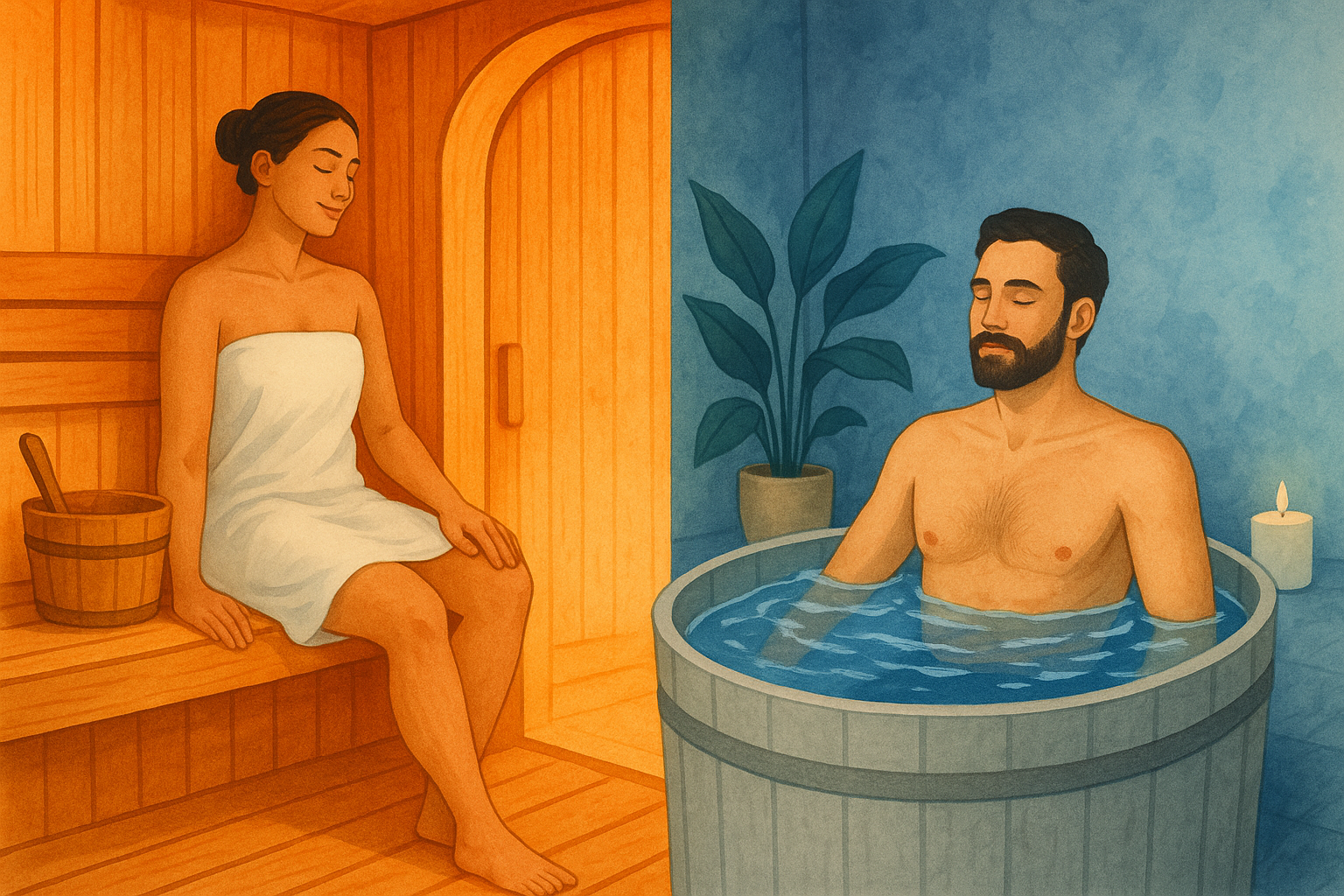
The Fall Immunity Blueprint: Create Greater Stress Resilience
Your Fall Body Armor
Fall is a season of change. The air cools, routines pick up speed, and our bodies are suddenly asked to adapt to shorter days and a busier pace. It’s also the time when colds and seasonal bugs seem to circulate more freely.
The good news? With a few intentional practices, you can help your immune system stay strong and resilient. Think of it as putting on your fall body armor: science-backed habits that make you less vulnerable to seasonal stressors and sickness.
Here are five powerful ways to support your immune health this season:
1. Contrast Therapy: Training Your Body’s Resilience
By alternating between heat and cold with contrast therapy you’re giving your circulatory system a workout. Heat exposure expands your blood vessels, cold contracts them, and the repeated flush of the two supports circulation, oxygen delivery, and faster recovery.
But the benefits go deeper than just feeling refreshed. Recent research shows that heat therapy can activate heat shock proteins: molecules that help repair cells and reduce inflammation. It also boosts white blood cell activity, which plays a direct role in your body’s ability to defend against infection.
As we highlighted in our sauna vs. hot tub blog, these immune-supporting effects aren’t just theoretical, they’ve been measured in people who use sauna regularly. Pairing heat exposure with a cold plunge may amplify this effect by keeping your system adaptive and resilient, especially as the seasons shift.
Many people leave a session feeling both energized and grounded, two qualities your immune system thrives on.
2. Load Up on Fall Greens & Seasonal Veggies
It seems like nature gives us exactly what we need, right when we need it. Fall vegetables like kale, spinach, squash, and sweet potatoes are packed with vitamins and minerals that strengthen immune defense.
Vitamin C from leafy greens and bell peppers supports white blood cell function.
Zinc from pumpkin seeds helps your body fight off viruses.
Beta-carotene in carrots and squash regulates immune response and keeps your skin (your first line of defense) healthy.
Making seasonal produce the star (or supporting character) of your meals is one of the simplest ways to stay nourished through the fall.
3. Don’t Let Vitamin D Slip Away
With shorter days and weaker sunlight coming soon, our natural production of vitamin D drops off just when we need it most. Low levels are linked not only to lowered immune resilience but also to seasonal mood changes.
Get outside for 20–30 minutes during midday when the sun is strongest.
Consider a high-quality vitamin D supplement. I used to take 1,000-2,000 iu per day throughout the year but have bumped it up as high as 4,000 - 5,000 in the winter and even higher if I feel a cold coming on. Recent blood testing showed that this paid off for keeping my Vitamin D levels in an optimal range, something that most of us struggle with.
Think of it as topping up your body’s sunlight bank account. While Vitamin D stores
4. Prioritize Sleep as Your Daily Reset
Sleep is the unsung hero of immune health. While you rest, your body produces cytokines to help fight infection and inflammation. Skimping on sleep can leave your immune system under-prepared.
Practical ways to support better rest:
Create a simple wind-down ritual (screens off, lights dimmed).
Take a warm shower or bath to signal your body it’s time to rest.
Try a short meditation or breathing exercise to quiet your mind.
Consistency is more important than perfection. Even small improvements in your sleep routine add up to stronger defenses.
5. Move to Circulate, Not Exhaust
Exercise supports immunity by improving circulation and reducing stress hormones. But the goal isn’t to push yourself to the brink every single time. Overtraining can actually weaken defenses.
Gentle, consistent movement is best:
Daily walks, ideally outdoors for light exposure
Yoga or stretching to release tension
Cycling, swimming, or light strength training at a comfortable pace
The key is to move enough to feel invigorated, not depleted.
Building Your Fall Body Armor
Immunity is built by laying on small, supportive habits.
By combining:
Contrast therapy for circulation and immune support
Seasonal nutrition for steady energy
Vitamin D for light and mood balance
Restful sleep for nightly repair
Gentle movement for daily flow
…you create a natural shield against the stresses of fall.
And if you’d like to experience contrast therapy firsthand, our infrared sauna and cold plunge or full contrast therapy sessions are designed to help you reset and recharge. Pair it with your other wellness rituals, and you’ll step into the season with resilience and calm.